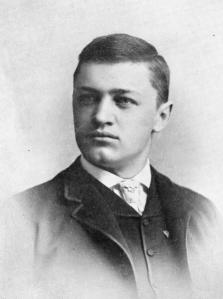
Three Rivers
Hudson~Mohawk~Schoharie
History From America's Most Famous Valleys
Dominie John Jacob Ehle and his Descendants
by Boyd Ehle, E. E.
Published by Enterprise and News, St. Johnsville, NY. 1930
Boyd Ehle
Key
P=Palatine Line
M=Minden Line
C=Canajoharie Line
FOREWORD--Veneration
of ancestors and parents, so salient a characteristic of oriental races and
primitive people is but an occasional incident in our feverish occidental civilization.
This
memoriam is a tribute to a humble pioneer family and its associates, exiles,
far from their homeland and kindred who shared many perils and sacrifices that
helped to make way for our present prosperous and sheltered life.
A master poet has written:
"Look now abroad, another race has filled
Those prosperous borders, wide the wood recedes,
And towns shoot up and fertile fields are tilled
The land is full of harvest and green-mead."
-BRYANT.
As usual with pioneer people in a strenuous struggle for life and sustenance, their history is somewhat neglected, passed along by word of mouth and scantily in written records. With the pressure of increasing numbers and the passing of the hostile Indian barrier at the west of the Mohawk Valley, the dispersal of the Palatine families began after the Revolution, gradually helped by easier and quicker transportation facilities by the development of water routes and canals followed by railroads, and now we have the automobile and aeroplane. This has made it easy for people to quickly move out of sight and tracing. Then the good old custom of recording in the family Bible statistics of births, marriages, deaths and bits of family history declined rapidly and has now nearly ceased, so much history has been buried in the grave with the old timers. This record is taken largely from hitherto unpublished family files supplemented by associated data gathered from various sources. It is regretted that, aside from the writer's direct line, so little is available. It is hoped that this record may serve as a framework for additions and revisions by descendants who may have additional information. In adapting Palatine names to English the name Ehle which came into general use only in the third generation had many variations in spelling and pronunciation in attempts to conform to the pronunciation "Ale" of the German. Among the official papers in family files of deeds, agreements, receipts, etc., these freakish variations occur in the spelling of the name and usually do not conform to the signature-Ehel, Eall, Oel, Eell, Ehl, Ehly, Oele, Ele, Ael, Ale, etc. In such a publication as the service lists of New York in the Revolution, due to different spelling the same man has several records. In the first U. S. census of 1790 all of the EhIs are listed as 'Ayle'. Of the two forms used by Dominie Ehl, the first of the family in New York, "Oel' Is the German for oil and Ehle from Ehl is the old equivalent of the English "ell" or yard but this word does not conform to the original pronunciation. Another confusing item in many cases is the variable records of birth or age, which are often inconsistent, due apparently to lapses of memory unchecked by written records.
The habit of using a repetition of a few baptismal names in the various lines of a family now causes uncertainty in placing a detached item in the proper line. In this memoir the usual practice of calling all the German settlers "Palatines" is followed and may include emigrants from other German states than the upper and lower Palatinates. The writer has tried to make the best disposal of the data now available to him and invites the help of others who may have the Ehle data. To follow up this ancestry to its conclusion alone would involve much delay before publication.
For convenience and clarity the Ehle family of the Mohawk Valley is treated in three lines conforming to their location in early Colonial times in the present towns of Palatine, Canajoharie and Minden of Montgomery county, N. Y. No extended attempt has been made to trace the families after the third generation In America or after they moved away from the Mohawk valley. That the descendants can add to the foundation now given.
Dominie Johannes Jacob Ehl (P. 1.) Colonial Pastor and Missionary to the Indians.
In the closing years of the seventeenth century the armies of Catholic Monarchical France ravaged with fire and sword the peaceful Protestant German Rhineland States. The apology for these ruthless raids was made that they were punishment for aid and shelter to Protestant refugees from the fratricidal religious wars of France, but back of that excuse was the lust of conquest of those fertile border states.
Unfortunately at that time those small German states were not confederated for united resistance and due to the dilatoriness of their coreligionist nations, England, Holland and Prussia, the Rhineland states, alone were unequal to an effective resistance. The survivors of these ruthless raids, with the few things they could carry, fled either overland to Prussia or down the Rhine to Holland and on to England.
A contingent reason for the exodus of 1709 and later years was the attempt by the new Elector Palatine, a Catholic to coerce the Protestants into accepting his religion. It then became a question of freedom of worship on which the sturdy Germans would not compromise. The only alternatives were death or emigration. They chose the latter.
England received the impoverished refugees with kindness and charity, then aided them to establish new homes. The story of their dispersal to Ireland, the Carolinas, Virginia, Pennsylvania and New York is well told in the Story of the Palatines. These people preferred the unknown risks of the New World to carve out their own future to again becoming vassals in Europe. Time has long since proved the wisdom of their decision and by a queer twist of fate the Palatines became participants In founding a great nation whose sons and resources were spent freely to save Republican France from monarchical Germany in the World War of 1914-19, thus reversing the events of the Palatines exile and returning good for evil. The long pilgrimage of the Palatines to their Land of Promise, the Mohawk Valley parallels in a general way that of the Jews under Moses to their Land of Promise, Palestine, and like the Jews, the Palatines were guided and sustained In the perils and privations of their exodus by their ministers of the Gospel.
Among these humble servants of their God and people was Johannes Jacob Ehl, born about 1690 of peaceful Rhineland folks and tutored in learning at the grand old university of Heidelberg.
With his people he went to England where in August, 1722 he passed the examinations and was ordained in the ministry by John, Bishop of London, receiving two degrees in a week. The two parchment diplomas in Latin are yet in the family files. A photograph copy with English translation is herewith attached. The certification of the good Bishop leaves nothing lacking as a testimonial of character and fitness. In the photographic copy of his acceptance of the Articles of Faith and signatures In the Registry Book, Latin Is used. The two subscriptions vary slightly. In one Dominie Ehl uses a Latin variation of his name in the signature. English translations are:
August 12th, 1722.
"I, Johannes Jacobus Ehl, scholar admitted in to the sacred order of Deacons,
do sign today the above written articles and everything contained In them joyfully
and willingly." Johannes Jacobus Ehlius.
August 19, 1722.
"I, Johannes Jacobus Ehlius, scholar admitted into the sacred order of the church
sign here the three above written articles and joyfully and willingly sign everything
contained in them." Johannes Jacobus Ehle.
Shortly after these ceremonials Dominie Ehl went aboard the emigrant ship on his way to New York. Such voyages by these landsmen in a small overcrowded, poorly equipped and provisioned sailing vessel at stormy season of the year was so trying that many were sick and some died at sea. The survivors were in a wretched state on their arrival
New York harbor, October 27, 1722, that they were ordered quarantined. A medical survey showed no infectious sickness and the emigrants were shortly allowed to land to begin their trip up river in search of homes and their kinsfolks who had preceded them.
The experiment of using the Palatines in making tar and naval stores failed because the pine trees were not the right kind. Some of the Palatines elected to stay in Livingston Manor and its vicinity as farmers but about half of them had moved to Schoharie where they found good farm land. Here again by the connivance of politicians and land speculators the Palatines were in trouble. To avoid exploitation the bolder spirits began to migrate to the Mohawk Valley and down the Delaware River into Pennsylvania. In 1716 the census showed 680 persons In Schoharle.
On his way up the Hudson Valley Domine Ehl visited the early settlements and for a time substituted for the Rev'd. Haeger at Sowengen (Kingsbury). He found the people too impoverished to contribute sufficiently to the church and ministry and moved on to Albany. There he was in touch with Dominie Petrus Van Driessen, who was identified with the Indian Mission work in the Mohawk Valley. Their association was to have a great influence on Dominie Ehl's future life.
Another great influence at Albany was that he loved and married, June 17, 1723 Johanna Van Slyck, a daughter of Pieter Willemse and Johanna Hanz Barheit Van Slyck of Kinderhook, N. Y.; a grandson of Pieter Van Slyck who came to America about 1630 and settled near Beverwyck. He probably was a brother of Cornelius Antonisse Van Slyck, 'Brer' Cornelius the Indian trader, who married Oshtock, the half breed daughter of the Frenchman Hartell and a Mohawk woman.
Shortly after their marriage Dominie Ehl and his bride started up the Mohawk river by canoe to the landing for the overland travel and along it to their new home and his pastorate at Schoharie.
In addition to his church work at Schoharle, his duties took him over to the PaIatines along the Mohawk river and at Stone Arabia. At the latter place he founded a church and was its first pastor. He held services also at the 'Falls' (now Little Falls, N. Y.) and his duties included mission work to the Mohawk, Oneida and Tuscarora Indians with visits to their villages on his circuit. Later, with his patron, Petrus Van Driessen he established the mission on the left bank of the Mohawk river, at the ford opposite the Middle Mohawk Castle of Tarjioris. To this place, now in Nelliston, N. Y. he moved his home as a more central location for his work, although for a time continuing pastoral work at Schoharie. Like many pastors in a new country with scant and scattered population, his duties were those of a circuit rider-not often however on horseback, but on foot and by canoe. Church or mission service followed his arrival, with the usual crop of children to baptize and young folks to marry. These trips out along the forest trails and by canoe, in all kinds of weather were very trying and gave him but a scant living eked out by small contributions by the settlers and his salary or gratuities from the Society for the Propagation of the Gospel in London. Along with many self-sacrificing missionaries he had the spiritual satisfaction of his work as a disciple of Christ fulfilling his mandate to carry the gospel to the heathen, which has been the incentive to so much self-sacrifice alike by Protestant, Catholic and Jewish missionaries in many countries.
The Mission of the Mohawks was established in accordance with the authorization in 1723 by William Burnett, Colonial Governor to Petrus Van Driessen.
"Whereas the Reverend Mr. Petrus Van Driessen of the county of Albany having presented to me the necessity of erecting and building a public meeting house for the Indians in the Mohawk country in the County of Albany in order for the more commodious and frequent assembling of themselves together for the solemn worship of God, which might be a means of bringing over, as well, the Indians there, as those in ye adjacent parts, to ye knowledge of the Christian religion; and has therefore made application to me for my lycence, and for that purpose now, for the furtherance of which design, I do, by virtue of the powers and authoritys unto me granted by virtue of his Majesty's letters patent under the great seal of Great Britain, give and grant unto the said Petrus Van Driessen full power, liberty, leave and lycense to erect and build a meeting house for the Indians in the Mohawk country, In order to the assembling of themselves together for ye solemn worship of God and that in any part of the lands to them belonging, as shall be found most convenient for the purpose aforesaid."
A temporary log house mission was first erected followed in 1727-28 by a single story rubble masonry building of flat field stones, roofed with hewn pine rafters and split shingles. A door and window with shutters were at each side. This hall in which the services were held, had a tamped earth floor. The family at first lived in a log house. Their nearest white neighbors was the family of Harmanus Van Slyck, who lived a short distance down stream. He was killed In the early part -of the battle of Oriskany in 1777.
In 1752 Dominie Ehl's son built the house addition to the mission and his Initials, P. E. 1752, are in the round recesses in the south gable end. This story and a half building was of similar construction to the mission in its walls and roof, but had two floors and a cellar. Under the eaves and at the sides of the doors and windows on each side were the loopholes for gun fire. The brick for the chimneys and the finishing lumber was brought from Schenectady.
Not forgetting his civil obligations and in conformance with the law Dominie Ehle took the citizenship oath at Albany October 14, 1732. In 1732 he bought the land of Lot 1, Harrison Patent at the mission from Philip Schuyler that ever since has been the Ehle homestead. The easterly 100 acres was sold to George Eacker.
Following their home building the clearing was gradually carved out of the forest and along the river flats for farming. This opened up the view across the valley. The house stands on a slight elevation above the river flats so that the Indian canoes on the river and later the barges of the settlers could be seen as they passed.
On the river trail in front of the mission, the Indians traveled back and forth to trade or for conferences with the officials at Albany or Sir William Johnson, the Indian agent. Westward the settlers passed in search of homes or eastward to trade at Schenectady or Albany. By the ford across the river and through the clearing settlers and Indians passed to Stone Arabia and beyond, or across the river and down stream to Schoharie or by the Otsquago trail to the Susquehanna country. Over on the hill in front were the bark huts of the Mohawk village with camp fires smoking by day and twinkling like fireflies at night. Out of the surrounding forest strode the hunter, red and white with his kill, stopping to look at the home and children. Sometimes, that great man of the valley, Sir William Johnson passed on his way to conferences with the western Indians or marched his farmer militia and Indians to the French and Indian wars. Those were great days for the Dominie and his family when his genial patron stopped for greeting or refreshments.
The kindly Dominie won the good will of the Indians by his ministrations and on their arrival the Mission and the basement were their quarters, with their campfires in the clearing out in front. The saying that the Indian never forgets a kindness did not fail. No war danger ever reached that family or house while they were on guard. The family passed in time but the house staid on until vandals of the present days began to wreck it in times of peace, searching for relics or treasures.
That the local Indians, the Mohawks guarded well their missionary, his family and home was shown both in the French-Indian wars and the Revolution. When the Mohawks were strong enough no foe-man could reach the Mission and when the French-Indian raids were on that they could not resist, their warning came in the night to flee. In the Revolution the Mohawks were largely outnumbered by the Senecas, Cayugas, Onondagas and other fierce western tribes over whom they had but limited control. Again they warned Dominie Ehl's family when it was too dangerous at their home for their protection: The family would then cross to the island at the ford at night and with their canoes paddle downstream to their kinsfolks at Albany and safety. The house was always unharmed when they returned, once after an interval of two years.
In the urgent haste of one of those flights, the family silver and heirlooms were taken out in the darkness by the cellar way and buried In the forest a short distance away. No lights could be used and in the haste and anxiety the hiding place was not well located. This could not be found when the family returned and has not to this day, in spite of many searches by the family and treasure hunters, the latter often using divining rods, incantations and what not.
Possibly some watcher may have seen the treasure buried and secured it.
In times of peace the settler cleared the land, made their homes, planted their crops and raised their families. Shutting them in on the north and west was ever the menace of their old French persecutors in the Palatinate with the addition of Indian allies, eager for any opportunity to ravage the Mohawk valley settlements in ruthless raids.
Then the chill of terror was felt alike by Palatine and Iroquois. The hatchet and scalping knife would spare but few captives and those often reserved for torture worse than death. The torch completed the destruction of homes as the nights flamed red. Those were dread days for women and children. Those who escaped fled to palisaded houses called forts or to hiding places in the forests. The men fought or stood guard until the raiders took the back trail to Canada with their captives, as occurred in the raid on German Flatts in 1758. Such times for the Palatines awoke the sad memories of the rapine along the Rhine from Cologne upstream to Philipsburg in their homeland.
Again they sturdily faced the future, closed up their ranks left by the burial of the dead, rebuilt their homes and tilled their fields. The dominant characteristics of the Palatines, obstinancy and courage would not to be denied, as witness their behaviour on that dread day of Oriskany when all seemed lost and death to all was at hand.
To Dominie Ehl those days of horror were only more in a lifetime of many like happenings when his ministrations were most necessary. His the duty to console the bereaved, to cheer them with the gospel's messages of hope and to bury the dead. His family was not entirely free from bereavement as his nephew John EhIe, the trader and Clock were slain and scalped at the German Flatts raid in 1758. He had barely escaped a like fate two years earlier at the carrying place between the Mohawk River and Woods Creek.
In 1758 Dominie Ehl who had reached the Biblical age limit of three score and ten, was yet in harness. Time was however slowing his pace but not his will to serve. His circuit trips were fewer with the passing years, until his services were limited to the Mission. Others as zealous coworkers shared in the local pastoral work of the valley, the Reverends Rosecrans, Schuyler, Wernig, Luppe, Gros, Weiss, Pick and Wack.
Time cannot be denied and as the old Dominie lived on at the Mission he brooded over the rapidly developing peril in the increasing friction of the colonists with Great Britain, due to excessive and unpopular taxation and denial of home rule. Dominie Ehl's patron, that great man of the valley, Sir Wm. Johnson, had greater worries over the oncoming peril that meant fratricidal strife and collapsed under its burden in July 1774, thus escaping the anguish of the Revolution. The control of the Indians then passed Into less capable and unscrupulous hands with the now well known awful results.
Dominie Ehl was 85 when the fratricidal war began, exceeding in its horrors all in his long experience. Families, kindred and neighbors were arrayed against each other in ruthless strife. Nearly 700 able bodied men went as Royalists to Canada, or about one-third in the valley of those fit for military service, many to return with the Indians under Johnson, Butler and their like in ruthless raids on their kin and neighbors. All attempts, by the Colonists, to keep the Indians neutral, failed before the lure of bribes and British scalp bounty. The great Pitt, Earl of Chatham, and his followers, the best of Englishmen stood bravely out against such a savage policy and went down to defeat in the British parliament. Many British officers and soldiers openly disobeyed and scorned such a ghastly policy recognizing it as their greatest handicap. Murder and scalping of women and children was generally limited to the partisan Tory and Indian raids. Some instances of hideousness were not lacking on the side of the Colonists, as told in 'A Century of Dishonor' by Helen Hunt Jackson. Fratricidal wars are the most cruel, but there are always outcasts and criminals In all nations, even in times of peace, to transgress all moral and social laws.
Again Dominie Ehl's family and the Mission were spared. At 87 he lived to hear of Oriskany's bloody day, to mourn the bloody toll of life taken from his people, and to brood over the unknown outcome of their sacrifices. Estimates of the loss to Tryon county are two-thirds of the people lost; and of the remainder 380 were widows and 2,000 fatherless children, seven hundred buildings had been burnt and 12,000 farms laid idle.
Death was kind when he came for the old Dominie and with the burden of 92 years he passed peacefully to rest. He was burled in the old Frey burial place near the present Palatine Bridge, N. Y. He, like another minister of his people in the exodus from Egypt and Pharaoh, when almost at the goal, was denied entry with them to the realization of their hopes-freedom of religion and government and peace.
Some reminiscences of Domine Ehl survive along with the information in documents and his report letters between 1724 and 1770 to the society for the Propagation of the Gospel. The letters, however, give limited personal items and treat chiefly of his work as a missionary and colonial pastor, of inadequate financial support the terrors of the French and Indian raids and the discouraging response of the Indians to Christian teaching. As an Illustration of parsimony in supporting the Colonial pastors 30 pounds local money, about 75 dollars, was the annual fee. Simms quotes one dollar fee for a marriage service and gives an anecdote of a groom paying but fifty cents to a pastor who had to walk five miles each way for the ceremony. A worse experience befell Dominic Ehl after a similar long jaunt out on the Otsquago trail for a wedding. The ceremony was followed by refreshments and jollification, then the happy groom approached the Dominie, who was preparing to leave, and asked about the amount of his fee. As usual with pastors he replied that was left to the generosity of the groom; "All right," shouted the happy man, the Dominie is a fine fellow, give him another glass of cider." The Dominie's reply is lost to history. Another interesting ceremony was officiating at one of the marriages of Brant, a protege of Sir William Johnson, who later became the noted war chief of the Iroquois and the scourge of the Valley.
Disappointment at the results of the Indian mission work was general and could not have been otherwise as subsequent events showed. The missionaries in their zeal attempted to rush the Indians into a worship they could not understand after centuries of savage life, worship and customs. The Indians' reverence was to a God of nature whom he saw all around him. A conception of an unseen God and the Holy Trinity was beyond his mentality. His religion was one with ceremonial feasts and dances for favors from God or to propitiate and ward off evil. Because of those ceremonials some of the few services of the Christian religion, especially those of the Catholic church, aroused in him a transient interest. The Jesuits had for a time a noticeable measure of success, due to this and their unparalleled energy and sacrifices. That waned when the Jesuits were banished or withdrawn.
The advent of the white man with his new vices and diseases was the doom of the Indian without regard to the question of religion. The Indians had never known small pox, measles, typhoid and venereal diseases brought by the white man. Those diseases would not yield to the incantation of the medicine man, and, with no competent doctors available, the Indians died like flies when afflicted by those contagious epidemics.
The Indians' moral code and government avoided the dangers of greed by a communal life. Like the ancient Greeks they cultivated strength, bravery and endurance. They did not, like the white man, lust for riches in land and valuables. But the settler took their land and deprived them of their hunting grounds and subsistence in game and the trader took their furs and other possessions. Both often drove a sharp bargain by befuddling the Indians with liquors. The Indian had not known liquor and he was absolutely helpless against his appetite, as long as he could obtain liquor by any sacrifice. Among the many appeals by the Indian chiefs against liquor none Is more typical than that of King Hendrick of the Mohawks at the Colonial convention at Albany in 1754.
"Brethren, here is an affair about which our hearts tremble and our minds are greatly concerned. We refer to the practice of selling rum in our castles. It destroys many, both old and young. We are in great fear about the rum. It may cause murder on both sides. We, the Mohawks, of both castles request that the people who are settled about us may not be suffered to sell our people rum. It destroys virtue and the progress of religion among us." All their pleas, those of their friend and agent Sir William Johnson, Dominie Ehl and associated pastors, backed by the Colonial government were as futile against liquor as the present efforts backed by all the resources of the United States government. In Canada liquor and the Indians were handled far better due largely to better conditions, a higher and more homogeneous average grade of citizens, better law enforcement and more respect for their laws.
Another adverse influence against the Indians' acceptance of the white man's religion was the result of their inborn habit of taking any white man as typical and responsible for his race and religion and the Indians found some very poor exhibits.
These inherent causes and the defeat of the Indians along with the British led to the Indians moral, physical and social decline as they were forced from their homeland and that no religion could have averted.
Of the old associations only the Mission lingers on. Gone are the great forests before the woodsman's axe. Across on the river hills the bark huts of the Indian village disappeared long ago and in their place stands out the residences, spires and factories of a white man's village, Fort Plain. Out on the once care-free crystal Mohawk, no longer the Indian paddles his canoe, but on a sewer river, shackled by civil engineers in a series of pools are the power driven barges of the white man's great commerce. Along on the river trail where the red man once strode with noiseless moccasined feet, white men now drive the roaring giant locomotives with their great trains on a four track ironway. High overhead the noiseless flight of pigeons no longer darkens the sun but the motorplane of the man bird roars as it saws the air. Progress was inevitable but it was not always kind. Such has been material progress but has the development of character morals and virtue kept pace or declined? Let the reader study the abnormally high criminal statistics of the United States and then judge for himself.
The lifework of Dominie Ehl was his efforts for the spiritual uplift of a future great people in their infancy and showing the way in religion and culture to a primitive savage people. The church he founded at Stone Arabia in 1723 in a log cabin, lives on in the stone church of 1788 that succeeded the frame church of 1733 , burnt by Sir John Johnson Oct. 19. At Palatine church the church he founded in 1729 in a log cabin carries on in the stone church of 1770 that is one of the outstanding monuments of the old times in the valley. At Schoharie, Indian Castle and Little Falls the churches he founded carry on. From these foci of his religious teaching, his influence radiated and was spread with the descendants of the pioneers as they founded new homes in all parts of the United States and beyond. The influence of his missionary work with the Indian tribes went with them in their banishment to the west and Canada helping them on their way to civilization and betterment. Thus the humble self-sacrificing pioneer pastor's foundation work carried on not only for his people and children but lives in the betterment of the generations long after his death.
Van Driessen-Ehl Land Grant
Here is the appreciation of the Mohawk nation of two of the pioneers in their grant of land, May 9, 1732 (2 v).
"To and for and in consideration of the love, good will and affection which we have and bear for the Revd's. Petrus Van Driessen and Johannes Ehl, etc." This grant of approximately two thousand acres, was subject as usual to the approval of the colonial government, to whom a petition was made Sept. 9, 1732. As usual this was referred by the Governor to the Board of Land Commissioners, who issued an order of survey Oct. 23, 1732, followed by their report Oct. 26, 1733. This grant of land by the Indians joined the Harrison patent at its upstream limit and extended one and a half miles upstream and two and a half miles back from the river, and it had to be surveyed to avoid conflicts with prior rights. It included the mouth and lower part of East Canada Creek, and the present Beardslee farm. At its north was located the Snell-Timmerman patent of 1755, based on the Indian grants to the Timmermans and to the Snells of 1734.
Dominie Ehl's Family
Ehl's family Bible was taken by one of the daughters in the division of estate and its final disposal unknown, so that now the details of Domine Ehl's family; births, marriages and deaths cannot be definitely given. In one of his letters he states that his family consisted of his wife, three daughters and an only son. The daughters were Elizabeth, Magdalen and another name now unavailable and the son, Petrus. Three of them including the son were born prior to 1730.
The Information in regard to two cousins named Elizabeth Ehl Is not definite enough to determine which Johannes Ehl was their father. The following adjustment is the best possible with the present data.
Elizabeth Ehl (p 2) and John Tice were married Sept. 9, 1761. He had lived among the Mohawks in the valley and probably was of the same English lineage as Guilbert Tice, the first hotel man of Johnstown, N. Y. As Captain John Tice he accompanied Brant the Mohawk chief to England and later appears to have returned to the Mohawk valley as a resident and his name is in the Revolution list of Tryon county.
The other Elizabeth Ehl is noted under the Minden line.
Magdalen Ehl (p. 2) is noted as one of the sponsors of Johannes Dillenbeck at his baptism at Stone Arabia in 1747.
Little information now is available about the third daughter. According to one of Dominie Ehl's letters his son-in-law was of German lineage, had been a sergeant of colonial militia, where he had learned bad habits that got the sheriff after him and the Dominie had to pay a fine out of his slim purse to keep his son-in-law out of confinement.
The only son, Petrus Ehle, (p 2) named for the Dominie's patron, Petrus Van Driessen, but more often known as Peter was born at Schoharie and grew up in the pioneer life at the Mission. At manhood he was a farmer of the homestead, extending the clearing and tilling the soil. In 1752 he built the stone residence addition to the mission as heretofore noted. He married Nov. 19, 1762 Mary Magdalen Douw 1744-1821, descendant of Volkert Janse Douw and Dorothe Janse Van Breerstede, pioneer emigrants of 1638 from Friedrichstaad, Holland.
Along with farming Petrus
did trucking for himself and others on the river trail between Schenectady and
Albany and the Falls, now Little Falls, N. Y. One of his bills reads:
"His Majesty King George the Second to Petrus Ehle, Dr.
"In the year 1760, the ninth day Of June last, then being impressed in his Majesty's
service with two horses head and driver carrying stores across the Little Falls
on the Mohawk river and continued in said service sixteen days."
This was sworn to before Renier Mynderse, Justice at Schenectady, county of Albany, 28th day of November, 1760 and is signed Peter Ehl. Along with other farmers Petrus Ehl was a soldier in the colonial militia called out by Sir William Johnson for the French and Indian wars as a private, and then Lieutenant of Captain Harmanus Van Slyck's company of Col. Claus' regiment. His commission, signed by Governor Tryon is in the family files. In the Revolution he served as a private in Captain Helmer's company of the 2nd Tryon Co. militia, Colonel Klock commanding. His old flintlock with bayonet and carved powder horn, which were in the Saratoga campaign hang on the home library wall. The death notice of Petrus Ehl is in the Sand Hill church records as Sept. 22nd, 1807; aged 84 years, 3 months and no days and that of his wife, February 1821, aged 77 years, 1 month and no days. They are buried in the homestead cemetery on the hill at the east side of the turnpike near the Dygert road.
As an incident of his times and the old homestead, the battle of Stone Arabia took place but a short distance from the easterly part of the farm that William Ehl (C2), a cousin, farmed. At the alarm of the battle he loaded his family into the farm wagon and rushed them out in the forest to hide. After the defeat of Col. Brown's little army, Sir John Johnson and his raiders passed about a mile farther fast, near Fort Keyser on their way to Stone Arabia. William Ehl and George Eacker, his neighbor, aided in gathering and burying the dead and brought some still alive but dying to Ehl's house. Later the local stories said the house was haunted by the shrieks and moans of the dying. An anecdote of the battle was that Col. Brown was shot out of a small tree that he had climbed to look for the enemy.
The survivors of Col. Brown's men Including Peter Dygert, a neighbor's son, fled to Ehl's Ford where General Van Rensselaer's patriot army was coming up the trail on the right bank of the river. In spite of urgent pleas to cross and save the settlers at Stone Arabia, Van Rensselater refused and went on and spent the night at Fort Plain. The army crossed at the ford in the morning, caught up with Johnson's army late in the afternoon at Klock's Field and were defeating them when at nightfall Van Rensselaer let them escape by withdrawing his army to camp down stream nearly 3 miles at Palatine Church. For his blunders General Van Rensselaer was tried by court martial and acquitted. A family story was to the effect that when Van Rensselaer's army crossed the river a letter addressed to him was found by the scouts in the trail, stuck in a split stick and it was surmised that it was from Johnson. Those men had known each other at Albany before the war and this letter was rumored to have been the cause of Johnson's escape. Probably however, Van Rensselaer's bungling and dilatoriness were but the mistakes of an incompetent and untrained citizen put in charge of an army, because of social and political standing as happened in the Revolution. A critic has said wisely "War is a costly game of mistakes in which the victor makes fewer than the vanquished."
Military service in the valley militia was casual and transient. Settlers were subject to call in emergencies and might be in service a few days, weeks or months. Returning from war calls Petrus Ehl and others hurried home to neglected farming. In addition to the homestead Petrus Ehl owned 100 acres in the R. Bleecker Patent at Fort Plain, and In 1764 bought 420 acres of land in the Springfield patent of Johannes Vetterly being lot 4 that was assigned to Adoniah Schuyler, one of the partners in the grant. Both of the old deeds are in the family files and are so full of flourish writing that they are difficult to read. Such efforts seem to have pleased the scribes of those days. This lot 4 excepting 100 acres that was sold, was willed by Petrus Ehl in equal shares to his daughters Maria and Elizabeth. Petrus Ehl had three daughters, Maria, Elizabeth and Anastacia and an only son Peter.
Maria Ehl (p 3) married Feb. 25, 1790, John Diel, son of Henry Diel, a grandson of the pioneer Heinrich Frey whose home was about a mile down stream.
Elizabeth Ehl (p 3) born July 13, 1774 married Rudolph Dygert, apparently a descendant of Werner Dygert the pioneer of Stone Arabia. The church record gives the baptism of a daughter Maria April 3, 1796.
The third daughter Anastacia, married July 27, 1794, Peter Westerman, Jr., son of Peter and Maria Elizabeth Dunckel Westerman. Elizabeth Dunckel was a daughter of Johan Peter Dunckel from Zwelbrucken, Germany. The Westermans had a son Petrus for whom Petrus EhIe and Catherine Westerman were sponsors at the baptism.
Later the Westermans moved to the town of Sullivan, Madison county, N.Y.
Peter P. Ehle (p 3), only son of Petrus Ehl, born in 1768, died 1834, married Delia Nellis, daughter of Johannes Nellis a son of William and Magdalen Klock Nellis. Their lives were spent as farmers on the old homestead. Prior to his father's death Peter Ehle took over farmingall that tract of land between the turnpike and the river. After the change from the river trail in 1803, he built the stone house on the new turnpike at its junction with the road to Stone Arabia at the south end of the farm. His neighbor Nicholas Gros had bought the Van Slyck farm In 1806 and ran a road house. With this change of residence, the clearing of the upland part of the farm progressed and the cultivated area was increased.
Peter P. Ehle's 1768-1844 span of life covered the wars of the Revolution and 1812, the change from barge transportation on the Mohawk to "Clinton's Ditch" in 1823 and the building of the Utica-Schenectady railway.
An interesting receipt in the family files is that for a slave bought by Peter P. Ehle,
"I
acknowledge to have received from Peter P. Ehle the sum of two hundred and seventy
five dollars for a negro man, a slave named 'Done.' Feb. 14th, 1804. Witness
present."
his
Philip x Berg
mark
Philip Sternberg.
Slaving in New York quickly followed the early Dutch settlements and was taken up by the German Palatines in the early days of Schoharie as soon as they could buy them. Abolition began in the northern states In 1799, but was gradual in New York and Pennsylvania and lasted until 1840 in the latter state. The old slave burial plot is near a giant granite boulder of the glacial age, a short distance from the old house. An old assessment book presented by Anna V. Ehle to the Historical Society of Canajoharie gave the number of slaves owned by the citizens of Montgomery county.
The children of Peter P. and Delia Ehle were Lanah, Maria, Jacob, Peter and John P., Lana Ehle (p 4) married Garrett Nellis, a great grandson of the pioneer William Nellis. One of their children was Rufus Nellis who after retiring from his farm near Nelliston, ran a bus line in Fort Plain.
Maria Ehle (Polly) (p 4) married first Peter Wagner, a grandson of Colonel Wagner, second Peter W. Ehle, a grandson of William Ehle © 3) soldier of the Revolution. The children by the latter marriage were James, Horatio, Nelson and Chauncey.
Jacob Ehle (p 4), son of Peter P. Ehle, a lively and promising child, wandered out into the forest when his father was on a trip to Albany with wheat and died from eating some poisonous red berries.
Peter P. Ehle, Jr. (P4) succeeded his father on the old homestead. He was educated at Cherry Valley Academy and served as a soldier in the Sacketts Harbor campaign of the 1812 war with the rank of lieutenant. After the war he was a captain in the 19th New York militia in training. His records of court maritals of delinquents and their fines are in the family files. In the Sacketts Harbor campaign the soldiers were poorly equipped for the hardships to which they were exposed in winter. Lieutenant Ehle and others suffered severely in after life from rheumatism that often incapacitated them for farm work. He told of marching all day through the winter storms, often wading creeks and swamps, Soaking wet at night the soldiers would then cut hemlock boughs for a bed and try to sleep. In the morning his clothes would be frozen fast.
On his return from war he took up farming, but with indifferent success because of his poor health. He married 1818 Elizabeth, daughter of Peter and Maria Snell Dygert who lived on the adjacent farm. Peter Dygert had gone into the Revolution quite young in place of his father, who was in poor health He became the well known scout and ranger who fought at Oriskany, Caughnawaga, Johnstown, Stone Arabia and Sharon. His grand parents were the pioneers Johan Pieter and Anna Elizabeth Fox Dygert.
Peter Ehle (P 4) 1792-1864, had six daughters Catherine, Harriet, Maria, Elizabeth, Eleanor and Delia and an only son Peter.
Catherine Ehle (P 5) born March 2, 1819, married Reuben Lipe, son of Johan Casper Lipe of the pioneer Hans Casper Lipe family. They lived on the old Wormuth farm on the turnpike, about a mile west of Nelliston, N. Y. Their children were John M., Peter E., Nathan and five daughters, Mrs. Irving Pollock, Mrs. Anthony Kilts. Mrs. Mary Toole, Mrs. Alex Van Slyck and Elizabeth unmarried.
Harriet Ehle (P 5) born 1831, died 1868, married Levi Shaul of Columbia, Herkimer county, N.Y. where they lived as farmers. His grandfather and two brothers were captured in Brant's raid in 1778 and held prisoners In Canada until the end of the war. Levi Shaul was a town supervisor and held other political appointments. He had an only child Oscar, a teacher, who married Lida Helmer.
Maria Ehle born 1820, died 1907 unmarried.
Eleanor Ehle (P 5) 1823-1907 married James Ehle © 5) a builder of Fort Plain who died childless in 1907.
Elizabeth Ehle (P 5) married first George Cheese, second Mason. She lived after the first marriage in Chicago in its early days and later was a pioneer at Colorado Springs, Col.
Delia Ehle (P 5) married first Walrath, second Niles and lived at Oneida, N. Y. One daughter Lillian Walrath died when a young woman.
Because of his father's ill health, a result of his soldier service, Peter Ehle, Jr. (P 5) 1834-1917, took over the farm management at the early age of fifteen. His only schooling was several winters at the old red school house on the turnpike about a half mile westerly from the Nelliston cross roads. There he was a school mate of Webster and Chauncey Wagner, Dan Van Camp, and other children of pioneer families. Along with other dairy farmers he took up hop culture, getting the cuttings from his brother-in-law, Reuben Lipe and the cedar poles from beyond Ephratah with a start at 2 a. m., using two teams and sleighs all one winter. This venture was a success from the start and prosperity at last came to the old homestead.
The dairy farming developed rapidly, at first making cheese and butter at home, later at the Smith Creek factory, then taking the milk to the first condensed milk factory at Fort Plain and then followed by bulk milk shipment to New York city as at present. The farm furnished all the stone for masonry on the West Shore railroad near Fort Plain and some of its ties and lumber.
Peter Ehle (P 5) Married in 1864 Anna Veeder Dockstader, 1834-1914, daughter of Jacob J. and Anna Veeder Dockstader. He was a great grandson of Marks Dockstader of Fonda, a soldier of the Revolution and she was a great granddaughter of Simon Volkertse Veeder, a pioneer from Holland; and a daughter of General Abram Veeder, of Fonda. Children of Peter and Anna Ehle are Boyd, Louis C. and Florence.
Boyd Ehle (P 6) born 1866 was brought up on the home farm, educated at the Nelliston district school, Clinton Liberal Institute and Cornell university. Graduated as a Civil Engineer, he has been active in engineering and construction work up and down the American continent. He married in 1896 Grace Cook, daughter of Charles and Mary Snell Cook of Manheim, Herkimer county, N.Y. Charles Cook was a great grandson of Atwater Cook of Wallingford, Conn., a soldier of the Revolution, whose wife was Mary Bartholemess. The Atwaters and Cooks were among the first settlers of Wallingford and New Haven, Conn. Early in the seventeenth century. Mary Snell was a great granddaughter of Peter Snell, one of the two Snells, out of nine, who survived the Oriskany's battle and a direct descendant of John Jost Snell, the pioneer and participant in the Stone Arabia and the Snell-Timmerman patent of Snells Bush, Manheim. Boyd and Grace Ehle have two sons Loris C. and Ralph V.
Loris C. Ehle (P 7) educated at the Yonkers N.Y. schools and Stevens Institute of Hoboken, N.J., married Madge Mosher, daughter of George and Grace Jennings Mosher and lives on the ancestral Snell farm. They have two children Marian and Robert of the eighth generation in America.
Ralph V. Ehle (P 7) educated at the Yonkers, N.Y. schools, Johns Hopkins and Yale university is an assistant professor at Lincoln university.
Louis C. Ehle (P 6), educated at Nelliston district school, Clinton Liberal Institute and Cornell university, read law in Fort Plain and Chicago, studied at Northwestern Law School and was admitted to the bar in Chicago. There he practiced law in the firm of his cousins Albert and ??ry (can't read name) Veeder. Louis C. and Mabel Robbins Ehle have two daughters, Kathleen and Carlene of Chicago.
Florence Ehle (P 6), educated at the Nelliston district school and Clinton Liberal Institute, married J. Aylmer Failing, a son of George Falling of the Stone Arabia pioneer Fehling family. A daughter Elsie, (P 7) educated at the Fort Plain schools and Wellesley College, is a teacher.
John P. Ehle (P 4), 1786-1870, son of Peter P. (P 3) and Delia Nellis Ehle married Christiana Nellis, 1794-1826, daughter of General George H. born 1767 and Catherine Crouse Nellis of Freys Bush, N. Y. She was a daughter of George (1740-18,24) and Katherine Klock Crouse (1742-1819), and granddaughter of Jacob, 1690-1772 and Elizabeth Nellis (d. 1755) Kraus. George H. Nellis was a son of Henry H. Nellis probably a son of Hendrick Nellis of Palatine. The second wife of John P. Ehle was Alida Van Plank. Children by the first marriage were Jacob N. (P 5), Angeline, Joshua, George, Maria, Peter and Harriet Jane.
Jacob N. Ehle (P 5), born 1813, married first, Elizabeth Nellis, second Caty and lived at Fort Plain as a farmer and lumberman. His children were Helen, Hattie, Josiah, Menzo, Joshua, William, Alida and Libbie.
Helen Ehle (P 6) married Pelgo, Kelsey of Fort Plain. Their children were Jennie, Frank and Grace.
Joshua Ehle (P 6) was burnt to death in childhood.
Hattie Ehle (P 6) married George M. Dillenbeck and had a son James G.
Josiah Ehle (P 6) born 1834 married Mary Ann Alter, born 1833? and was a canal boat captain of Fort Plain, N. Y. Their children were Jennie L., born 1857, Robert 1859-1897, Charles born 1862 and Eddie, born 1861. (Note: date supplied by Mary Ehle--Josiah born June 20, 1836, died April 9, 1910 and Mary Ann Alter born May 10, 1834, died November 16, 1923. These dates will be verified in the spring.)
Robert Ehle (P. 7) married Harriet Reiser and had a son Robert J. (P 8), born 1892.
Charles (P 7) born 1862 and his wife Bell V., born 1859, live at Fort Plain, N. Y. where he was a coal dealer.
Eddie (P 7) and his wife Anna, born 1869 had two children Edna, born 1896 and Herman J. born 1907.
Menzo (P 6) born 1846 and his wife Elizabeth born 1850 lived at Fort Plain, N. Y. where he was a truckman.
George Ehle (P 6) born 1851, no further Information.
Alida and Libbie were twins born in 1847.
William (P 6) born 1856 and his wife Mary E., born 1855 had three children Willie Edgar born 1876, Chas. Eugene born 1878 and Maud born 1882.
Angeline Ehle (P 5) born Dec. 2, 1816 married William Van Plank.
Harriet Jane Ehle (P 5), 1818-1898, married Adam Bush. Their children were John, Byron, George, Lynn and Josephine who married Coursen.
Maria (P 5), 1822, married Charles Hinaman of Nelliston, N. Y. and had a daughter Jennie who married Chas. Luft.
John P. born 1816 and his wife Caroline F. Ehle had John, Lilla, George, Sophie, Anna and Nettie. He was a liveryman of Canajoharie, N. Y. but moved elsewhere and no further data of this family is now available.
George (P 5), 1820-1901, married Sept. 18, 1848, Eva Bush 1923-1891, daughter of Gottlieb Bush 1784-1840 and Juliana Casler 1784-1850. Their children were Jane Ann, Charles P., and John Oliver. He was a hotelman at Hessville, Fultonville and Johnstown, N. Y. After his retirement in 1898 he lived with his son Charles F. in Utica, N. Y.
Jane Ann (P 6) born 1847, died in childhood.
John Oliver (P 6) 1853-1912, married Henrietta More 1854-1901 of Johnstown, N. Y. They had a son Henry who died in childhood and a daughter Carrie (P 7) who married the Rev'd. Walker Gage, who have three children and live in California.
Charles Franklin (P 6), 1951-1913, married Sept. 25, 1872 Isabella McCall 1855-1880; second Oct. 7, 1884 Cora Bicknell Wicks, 1863-1928. Children by the first marriage were Mary Eve and George; by the second Russel Tracy, Charles, Edward Brisban, and Stanley Seymour.
Mary Eve (P 7), 1874, unmarried, is an assistant librarian of Utica, N. Y. who has supplied these notes for the John P. Ehle line.
George (P 7) born Dec. 6, 1875, died Sept. 1, 1918 in California.
Russel Tracy (P 7) born July 7, 1885 at Johnstown, N. Y., married in 1908 Olive Escott. They have a son George Escott Ehle (P 8), born July 2, 1913 and live at Scranton, Penna.
Edward Brisban (P 7) born June 25, 1893, married in 1920 Jane Baldwin Wilber and live at Utica, N. Y.
Charles Ehle (P 7) born 1891 at Pittsfield, Mass., died in childhood.
Stanley Seymour (P 7) born Nov. 4, 1896 at Utica, married in 1927, Nettie Olive Baldwin and have Patricia born Nov. 6, 1929 and Nettie Baldwin born July 3, 1928.
Canajoharie Line, ( C.)
Harmanus Ehl (C 1)
Harmanus Ehl ( C 1) a younger half brother of Dominie Ehl and a widower married Elizabeth Miller and came to America in 1745, settling on a farm near the present Canajoharie on the Maple town road. But little is now known of his activities which were the routine of a settler farmer making a home, clearing lead and cultivation of crops. The name Harmanus Ehl appears In the list of emigrants, taking the citizenship oath at Albany July 3rd, 1759. His house was palisaded during the Revolution and known as Fort Ehl. Seven sons were in the militia service. The family and home escaped injury in the Revolution. The children were Michael, William, Peter H., John, Anthony, Harmanus, Jr., Jacob, Lana, Nancy and another daughter.
Michael Ehl ( C 2) 1746-1825 married Janet Van der Werke. They settled at Stone Arabia where their lives were spent in farming, He served several enlistments in Capt. Klock's company, 2nd Tryon Co. militia. As a devout churchman he was prominent In the Stone Arabia church founded by his uncle Dominie Ehl and serving as deacon and elder. A tombstone in the church graveyard gives his death as 1825 and that of his wife Feb. 10, 1821, aged 72 years. But few items of information are available about this family except as noted in his will. Apparently the children scattered to other locations, They were William M., Harmanus M., John M., Elizabeth and Mary.
William M.c (C 3) had two Peter and Michael (C4).
Harmanus M.( C 3) married Elizabeth Dockstader, daughter of Frederick Dockstader of Fonda, N. Y.
Elizabeth( C3) married Sept., 1805 Peter Gardinier and had a daughter Caty.
John (C3) of Stone Arabia and his wife Rachel Gardinier had children Michael M., Dirky born Jan. 27, 1809, Betsy Moore and Peter M.
Peter M. (C 4) and Margaret Dillenbeck Ehle, daughter of Johannes Dillenbeck, had children: James born Oct. 15, 1808, Maria born June 6, 1812, Annnetje born Dec. 22, 1806 and Andrew born 1816.
Information by correspondence about this family line is invited.
William Ehl (C 2), 1749-1826, married Catherine Jordan and settled as farmers on the eastern part of his uncle Dominie Ehl's homestead with Jacob Eacker as his neighbor. There they lived quietly as settler farmers until the Revolution in which he served several enlistments with Capt. Bradbig and Bielly of the 2nd Tryon County militia. According to his papers, on which a pension was granted in 1818 his battle record included Oriskany and Johnstown. The incident of how he saved his family at the time of the battle of Stone Arabia is given with the history of his cousin Petrus Ehl (P 2).
William Ehl's first wife died about 800 and he married Jane Johnson, born 1764. His children were Harmanus W., John W., Michael W., William, Adam, Elizabeth, Jane, Emy Catherine and Peter W. W.
Harmanus W. Ehle (C 3) born 1781, married Anna Weiser, daughter of Nicholas Weiser, was a soldier In the 1812 war, and alive at 81 years of age.
John W. Ehle (C 3), born 1784, married Dec. 2, 1810, Catherine Wallrad, 1790-1844. They were farmers at Stone Arabia.
Michael W. Ehle (C 3) born June 4, 1789, married March 22, 1818, Elizabeth Nellis.
William Ehle, Jr. (C 3) born June 12, 1791 and wife Jennie had a daughter Phoebe.
Adam (C 3) was born May 16, 1794.
Elizabeth born Feb. 28, 1796 married May 10, 1816 George Dockstader and had a son Gustavus Adolphhus.
Jane (C 3) was born Oct 8, 1801.
Emy (C 3)) was born Nov. 22, 1802.
Catherine (C 3) married John Laney of Stone Arabia.
Peter W. married first Catherine Nellis who died Feb. 27, 1823, second Dec. 25, 1824 Maria Ehle (P 3) Wagner, widow of Peter W. Wagner.
Henry (C 3) born 1807 married Ann Bellinger, probably the daughter of John F. Bellinger of Oppenheim.
Archibald Ehle (C 4), son of John W., born Dec. 6, 1811, married Nancy Wagner, granddaughter of Johan Peter Wagner and was a Stone Arabia farmer.
Catherine (C 4) married Cyrus Shults.
Harrison (C 4) born May 24, IW4 and his wife Christiana located as farmers in the town of Sullivan, Madison county, N. Y.
Maria (C 4), no further information.
Michael W. Ehle (C 3) and Elizabeth Nellis Ehle had three children.
Betsy Ann (C 4), born 1819, no information.
William H. (C 4), born Peb. 25, 1821, married Minerva de Forest born 1826.
Caty (C 4) was born 1823, no information.
John Jacob (C 4) was born March 26, 1828, no information.
George M. (C 4) born 1826, married Maria Geesler.
Susan (C 4) was born 1833, no information.
Children of Peter W. Ehle and wife Maria were James, Horatio, Nelson, David and Chauncey.
James (C 5) born 1815, a carpenter and builder of Fort Plain, married his cousin Eleanor Ehle (P 5), no children.
David (C 3) and Louisa daughter of John R. and Elizabeth Loveliss had a son George W. (C 6) born 1867.
Horatio Nelson (C 5) born March 1, 1813 and wife Maria, born 1841, had three children: Adaline, Maria born 1843 and Catherine Alice born 1847.
Adaline (C 6) born 1841 was a teacher at Fort Plain.
Chauncey (C 5), 1812-1897, and his wife Nancy Hawn Ehle had these children: Helen, Wallace C. born 1837, Caty, Sherwood born 1846, Charles E., Martha born 1841, Louise born 1842, Melvin.
Helen (C 6) 1936-1906, married E. C. Chapman.
Caty (C 6) 1839-1901 married Ed. Deusler.
Melvin (C 6) was born in 1848, no information.
Charles E. (C 6) was horn in 1849 and Mary E. Ehle had LeRoy and Maud. He was in clerical work at Fort Plain.
LeRoy (C 7) born 1876 and his wife Hattie had a son Victor C. (C 8) born 1909 of Fort Plain, N. Y.
Maud (C 7) was born 1892, no information.
Archibald (C 4) and wife Nancy Wagner Ehle's children were Alvin, Arthur born 1840, Ella born 1843, Mary born 1845, Emma born 1847, Nancy born 1850, Archibald born 1854, Frances Ann born 1854 and Gertrude born 1856.
Alvin (C 5) and his wife Susan J. Day 1839-1927 had a son now the Rev. Archibald 1. Ehle of Carmel, N. Y. who married in 1863, Kate Hagadorn.
Children of Geo. M. (C 4) and Maria Geesler Ehle were Vernon, Marvella and Byron.
Vernon (C 5) was born In 1852 and lived at Fort Plain.
Marvella (C 5) born 1853, married James Rapp.
Byron (C 5) born 1860 and Kate Ehle had a son George B. (C 5) and grandson Ralph (C 7.)
Children of William H. (C 4) and Minerva DeForrest Ehle were Elvira Emma, Alonzo D., Lillian and Sarah.
Elvira (C 5) born 1951 married Seward Moyer of Fort Plain and had one son.
Emma (C 5) was born 1859, no information.
Alonzo D. (C 5) born 1862 and Emrna his wife, have retired from farming to Fort Plain where he is in the insurance business.
Lillian born 1870 married Smith and have a son C. D. Smith.
Sarah, no information.
Henry (C 3) and Ann Bellinger Ehle moved from Minden to Madison county, N. Y. Their children were Lena, Catherine born 1831 and Andrew J. born 1833.
John Ehle (C 2) born 1756-1795 married Rachel Goertner, daughter of Peter and Mary Catherine Goertner, emigrants from Germany, who settled in a farm near the west end of Ehle's Ford. John Ehle was a sergeant in Captain Van Everen's company of the 1st Tryon County Militia. A son, Harmanus I. was born.
Harnianus I. (C 3) born March 29, 1790, married Jan. 29, 1809 Christine Vrooman. He was a prominent citizen and merchant of Canajoharie. Their children were James R., Henry Eliza, Maria, Charles, Caroline, Harmanus, Catherine.
James R. (C 4) married in 1833, Catherine Loucks and died In 1861.
Henry (C 4) died in 1861.
Eliza married (C 4) died in 1860.
Charles D. (C 4) was born in 1816.
Catherine (C 4) born June 12, 1816, married Nov. 2, 1855, George C. Wetmore, born Nov. 18, 1809.
Anthony (C 2) born 1762 and his wife Engeltje Steeretsh Ehle had children: Clarissa born 1803, Margaret born 1805, Elizabeth born 1808, Herman A., John A., Sarah, Catherine, Peter A. and Cornelius A.. He served in Capt. Van Everen's company of the 1st Tryon Co. militia and later was a captain of state militia.
Harman A. (C 3) and his wife Maria Young Ehle had a son Herman A., Jr. (C 4) born Dec. 8, 1824.
John A. (C 3) married Feb. 24, 1817, Catherine Van Alstein.
Sarah (C 3) was born in 1812.
Catherine (C 3) was born in 1815.
Peter A. (C 3) married June 9, 1822 Betty Van Slyk. Their children were Angeline born 1823, Elizabeth born 1826, Sarah born 1828 and Margaret J., born 1829.
Cornelius A. and his wife Eva Hillegas, married in 182A had a daughter Nancy, wife of George H. Cline of Oppenheim, N. Y.
Harmanus Ehl (C 2) born 1762, married in 1789 Elizabeth Cornue, born 1773, daughter of Daniel and Sally Wessels Cornue and died at Canajoharie, March 12, 1844. He served as a private in Capt. Van Everen's company of the 1st Tryon Co. Militia. After the Revoludion he was a blacksmith at Canajoharie. Their children were Henry E., Daniel, Elisha, Maria, Jane Ann, Sarah, Marcus, Eliza and Abram B..
Henry E. (C 4) born 1822 died Dec. 3, 1902, married July 21, 1851, Almira Failing. Their children were Ardella, Daniel H., Harman H., Maggie and Eliabeth.
Ardella (C 5) married Jan. 2, 1885 Rev'd. James B. Gow and went to reside in California.
Daniel H. (C 5) born 1852, died 1906 married Gertrude Rice. He was a teacher and lived at Canajoharie. Their children were Mertie, Virgil and Ledro.
Mertie (C 6) married Charles Van Buskirk. Their children are Marcus A., and Charles D.
Virgil (C 6) born Feb. 2, 1884 and Ledro (C 6) born June 3, 1880 live at Gloversville, practicing civil engineers.
Herman H. (C 5) born Dec. 12, 1854 and wife had a son Almer B. (C 6) born June 11, 1902.
Maggie (C 5) married July 2, 1892 Aaron Keller and had a daughter Maria.
Elizabeth (C 5) born Sept. 3, 1859, married April 31, 1851 Charles Empie.
John (C 3) son of Harmanus (C 2) married Catherine.
Peter H. Ehl (C 2) 1754-1847 and his wife Gadlein had two sons and a daughter, David, Barnet and Dorothea. He was a captain in the transportation service of the Revolution under Colonels Willett, Van Schaick and Ganesvoort, for which in 1823 he received a pension. It is reported that he was with the men who delivered the last provision to Fort Schuyler as the siege began, but escaped the capture that happened to some of his comrades. After the Revolution he settled in Herkimer county, N. Y., apparently in the town of Danube and his children were baptised at Saint Johnsville. Very little information seems to be available about this family.
Dorothea (C 3) was baptized Jqn. 15, 1790.
David (C 3) was baptized January 10, 1791.
Barnet (C 3) was baptized April 7, 1792.
David (C 3) a lawyer and his wife Elizabeth born 1794 moved to the town of Sullivan, Madison county, N. Y. Their children were Elijah, Margaret and Harman.
Elijah (C 4) born 1825 had a son George born 1867.
Margaret (C 4) was born in 1830.
Harman (C 4) was born in 1833.
It is hoped that readers may furnish further information of this family line.
Jacob Ehl (C 2), the youngest son of Harmanus Ehl (C 1) born March 2, 1756, married first Jane Van Everen 1769-1805, a granddaughter of Reynier Van Everen of the first Tryon county militia and second, Rebecca Higgins, a daughter of Benjamin Higgins of Canajoharie. He acted as a sentry at Fort Ehl at an early age and afterwards lived as a farmer on the Ehle homestead. His children by the first marriage were Elinor, Elizabeth, John, Abraham and Maria; by the second Jane Catherine, Charles P., Fannie and Stephen Peck.
Abraham succeeded to the homestead farm when the family moved to Jefferson county, N. Y.
Elizabeth born March 7, 1795, died Jan. 15, 1845, married Martin Quackenbush.
Elinor (C 3)) born Jan. 16, 1793, died April 3, 1869.
John (C 3) born Get. 3, 1797 died Feb. 15, 1845.
Abraham (C 3) born Sept. 8, 1799, died July 26, 1897. He married Esther Reed. No children were born of that marriage but three were adopted.
Maria (C 3) born Nov. 1, 1802, died Dec. 20, 1882, married John Vrooman of Cherry Valley and they moved to Jefferson county where they had these children: Jane Catherine (C 3) born Dec. 15, 1810, died July 9, 1827. Charles P. (C 3) born Feb. 9, 1815, died March 10, 1817. Fannie (C 3) born Sept. 15, 1814, marrid Dr. Arndt of Milwaukee, Wis.
Stephen Peck born June 9, 1821, died August 9, 1822.
Apparently no grandsons of Jacob Ehle had male descendants. These notes are extracts from those of Miss Ella C. Gibbs, great granddaughter of Marie Ehle (C 3).
Of the daughters Nancy, Lana and another of Harmanus and Elizabeth Miller Ehl (C) but little information is now available.
Lana (C 2) married Johannes Helmer, a son of Gottfried and Anna Margaretha Helmer, pioneer settlers. They had a son John baptized Oct. 30, 1788.
Of Nancy (C 2) and the other daughter no information is now available.
Minden Line (M)
The information now available regarding this Ehl line is limited and in places lacks in definiteness, which descendants should be able to supply. Apparently the head of this line was the Palatine emigrant Johannes Ehl who took the oath of citizenship Sept. 11, 1761 and was another half brother of Dominie Ehle (P 1) and brother of Harmanus (C 1) of Canajoharie as the family relatives were intimate. The homestead location of this line was at Freys Bush, adjacent to Fort Clyde and the Nellis family with whom they intermarried with the daughters.
Johannes Ehl's children as far as known were John, Christian, Peter and Elizabeth.
John Ehl (M 2) was a barge man and trader on the Mohawk river, was killed with another trader named Clock at the siege of German Flatts in the French Indian raid of 1758 after barely escaping a like fate two years earlier at the carrying place to Woods Creek, as noted in Doc. Hist. N. Y.
Christian Ehl, sometimes called Hanchrist or John Christ, born Sept. 25, 1742, died Oct. 6, 1920, with his wife Eliza Klock, born May 15, 1745, died Sept. 16, 1822 had children John C., Catherine and Henry. He served with the continental militia and several enlistments in the first Tryon county militia in the Revolution and was a farmer at Freys Bush.
John C. (C 3) Feb. 2, 1766, died June 26, 1835 and his wife Delia Bellinger, a daughter of Johannes Bellinger killed at Oriskany who was a grandson of the pioneer Frederick Bellinger of the Burnettsfield patent and the 1711 expedition against the French at Montreal. Their children were John, Jr., Lana, Catherine and another son John E. who died before his father having a son John E.
Catherine (M 3) born August 30, 1782, died Oct. 29, 1868, married Jacob Zeller, born 1777, died 1863. He was a son of Jacob Zoller, wounded and lost at Oriskany. His son Jacob served in the 1812 war. The children of Jacob and Catherine Ehle Zoller were John F., Mary, James, Jacob, Josiah,
Henry, Chauncey, Abraham and Catherine. Josiah was the builder of the Zoller house of Fort Plain, N. Y.
Henry Ehle (M 3) married Lana Delchert (Dygert), a daughter of Warner Dygert who was murdered at the Falls by Indians during the Revolution. His mother was Magdalena Herkimer, sister of the General.
John Ehle, Jr., (M 4), son of John C., born 1794, died 1874 and Peggy Fraleigh, his wife had five daughters and four sons, Anna, Maria, Reuben, Caty, Lana John, Ebenezer and Morgan Parks. By his father's will John Jr. (M 4) was given a homestead at Sharon, N. Y., but he does not appear to have located there and no further information of this family is available except their birth dates, Anna 1815, Maria 1817, Reuben 1819, Caty 1822, Lanah 1824, John 1827 and Ebenezer 1833. Readers may be able to supply additional data.
Abraham (M 4) was willed the homestead farm in Freys Bush, but apparently, sold it and was a member of the firm of Young and Ehle of Albany. of the firm of Albany. He died in New York city March 24, 1886.
Lanah (M 4) born Oct. 22, 1796, married Jan. 19, 1815 Jacob I. Lipe, of Dutchtown, near Fort Plain, who was a son of John A. Lipe born 1764, a merchant of Fort Plain and descendant of Hans Caspar Lipe, made a citizen in 1715.
The will of John C. Ehle (M 3) gives provision for John E. Ehle, his grandson, whose father was dead. It does not give his name, which appears as John in John E. Ehle's staternent in which his mother's name is given as Smith.
John E. Ehle (M 5) born 1830, died 1907 married Martha Abeel and had two sons, Frank J. and Eugene.
Frank J. (M 6) born Sept. 9, 1863, educated at Clinton Liberal Institute, was a merchant of Fort Plain, N. Y., and one time mayor. He married Nettie Walrath. Their children are., Elizabeth and Russel.
Elizabeth (M 7), born January 24, 1890 married Roland Hoffman.
Russel Ehle (M 7) born 1899 rnarried Lulu Shults, daughter of Manly ShuIts of Fort Plain.
Catherine Ehle (M 4) born August 12, 1802, died 1892, married Abraham Diefendorf, born Sept. 30, 1801, died 1892, a descendant of the pioneer Heinrich Diefendorf who came as an immigrant in 1710.
Maria (Polly) (M 4) married Sol Timmerman, one of the sons of Theobald Timmerman of Dutchtown. He was one of the sons of Jacob Timmerman, early settlers at St. Johnsville who came in 1710 to America and was a participant In the Snell-Timmerman patent of Snells Bush, Manheim, Herkimer County, N. Y.
Elizabeth Ehl (M 2) born 1738 married in 1756 Johannes Schouman, born Dec. 14, 1732 in Germany and arrived in America in 1750. He was an expert wood worker and built the old Sand Hill church, near old Fort Plain, which was burnt in the Indian raid of 1780.
Johannes and Elizabeth Ehl Schouman had a daughter Anna (M 3) born Oct. 20, 1758 who married Nicholas Dunckel of Freys Bush and has many descendants. A second Schouman child, a boy, was born in 1760 but died an infant. John Schournan was murdered by Indians in 1760 while cutting timber in the woodlot at his home.
Peter Ehle (M 2), born Dec. 23, 1746 died January 25, 1829, married April 4, 1772, Catherine Nellis, apparently a sister of Henry H. Nellis of Preys Bush. He moved as a corporal in Capt. Adam Leyp's (Lipe) Co. of the 1st Tryon Co. Militia in the Revolution with a battle record of Sharon, Johnstown and Oriskany. At the latter place he was captured and witnessed the torture and murder of Isaac Paris and others by the Indians the evening after the battle in revenge for the loss of chiefs in the battle. On his return from Canada Peter Ehl lived as a farmer In Minden until about 1821, when the family moved to the town of Sullivan, Madison county, N. Y. where he died in 1829. His widow Catherine (Cadrina) survived him and received a pension Feb. 16, 1838. Children of Peter (M 3) and Catherine Ehl were Mary Elizabeth, Johannes, Anna B., Peter P. Lisbed and Cadrina, twins, Hendrick and George.
Mary Elizabeth born Feb. 5, 1773, married July 5, 1788 Johan Jung (Young), son of Johan Christ Jung of Minden, who was a son of the emigrant Johan Jung.
Johannes born born Sept. 25, 1774, the eldest son, married Mary Cradell and lived on a farm near his father in Madison county.
Anna (M 3) born May 3, 1777, no further information.
Peter P. (M 3) born June 25, 1779 and Hannah his wife lived on a farm in Madison county near his father but later moved to the town of Fenner where he died.
Lisbed (Betsey) (M 3) born April 9, 1785, died Feb. 7, 1859, married Feb. 7, 1804, Henry Fox, a son of William Fox a justice of peace for over 40 years in the present town of Palatine, Montgomery county, N. Y. Henry Fox and wife settled as farmers in Madison county and retired at old age to Chittenango, N. Y.
Of Cadrina (M 3) born April 9, 1783 no information.
Hendrick (Henry) (M 3) born April 13, 1737, succeeded his father on the homestead farm and died at Chittenango, N. Y. after passing on the farm to his son Oliver (M 4). Henry and his wife Eve's children were Oliver, Henry, Jr., Andrew, Abram, and Catherine.
Oliver (M 4) died in 1862 on the homestead.
Henry, Jr. was born in 1818.
Andrew J., (M 4) was born in 1833.
Catherine (M 4) born 1830 married James Hood and had two daughters Helen and Libbie (M 5).
Abram (M 4) died 1895, had a son Charles (M 5) of Sheboygan, Wis., Abram, Jr. Jarnes (M 5) died Feb. 19, 1885.
George (M 3) born Jan. 20, 1792, died July 10, 185.1, married Jan. 2, 1811 at Fort Plain, N. Y. Ann (Nancy) Nellis, born April 19, 1793, died July 1, 1841. She was a daughter of Henry H. Nellis, born Oct. 3, 1746, died April 22, 1829 and his wife Christiana, born Feb. 2, 1844, died June 14, 1827. George Ehle was the proprietor of the Dixie House, Chittenango, N. Y. and later of the Lucklen House, Cazenovia, N. Y. His children were Irene, Anne, Harriet, Charlotte, Sophie, George and Catherine.
Irene (M 4) born May 18, 1815, died Sept. 20, 1891, married April 24, 1834 0. K. Swift and had three sons, Edwin W., Charles B. and Oliver N.
Anne (M 4) born April 6, 1859 died May 8, 1900, married James Cole. and has children George E., James B. and Katie C.
Harriet (M 4) born Aug. 14, 1818, married Dean Knowlton.
Charlotte (M 4) born Feb. 26, 1820, at Fort Plain, N. Y. married John Bates.
Sophie (M 4) born April 8, 1823 married Sept. 20, 1840 Leonard Williams.
George (M 4) born Jan. 1, 18-96, died 1890, married May 15, 1845 Sarah Stewart. Their children were:
Charles S. (M 5) born Jan. 9, 1847.
Anna C. (M 5) born July 12, 1845.
Catherine (M 5) born Sept. 7, 1827, married in 1844 Samuel V. Clarke.
Maternal Lines
Except for brief notes in the preceding chapters this record is limited because of the lack of data. The important and large part the mothers played in the pioneer life unfortunately never was properly recognized in the old records and historical writings. History of old time usually treats of the doings of warriors, priests and politicians, who monopolize the written records to the exclusion of the humble citizens and women, but no one was more self-sacrificing than the mothers, who not only reared and cared for the family and had more than their share of suffering, privations and dangers of the pioneer life. Yet after marriage, among the Palatines, the wife's identity was merged with that of her husband and family and rarely mentioned, except sometimes in church records or legal papers. Available records of the maternal lines follow. It is regretted that they are so scant and entirely inadequate.
Cook Line
Grace Cook Ehle, wife of Boyd Ehle (P 6) is a daughter of Charles Cook, born April 14, 1848, died Jan., 1907, who married Jan. 13, 1869, Mary Snell. He was a son of Chauncey Cook, born August 16, 1822, who married Feb. 26, 1846, Jane Getman. Chauncey Cook was a son of Friend Cook, born Jan. 27, 1792, who married Nancy Foote, born July 29, 1799. He was a son of Atwater Cook, born Nov. 3, 1758 and his wife Mary Bartholemess, born June 25, 1758. Atwater Cook was a direct descendant of Henry Cook of Birmingham, England and John Atwater of Kent, England, who emigrated to Massachusetts in the early sixteen hundreds and became a pioneer settler at Wallingford, Conn. prior to 1640. The Cooks and Atwaters had various intermarriages.
Atwater Cook was a soldier in Capt. Brackett's company, 5th Battallion of Wordsworth's Brigade of the Connecticut line, who participated in the battles of Long Island and White Plains in the Revolution. After the war, along with other New England families, he settled on a farm at Salisbury, N. Y. His grandson Chauncey Cook lived on his farm near Little Falls, N. Y. and his son Charles bought the Jehoram Snell farm in Snells Bush, now farmed by his grandson Loris Cook Ehle.
Snell Line
Mary Snell Cook, mother of Grace Cook Ehle, was a daughter of Jehoram Snell, born July 31, 1923, died Oct. 31, 1907, who married Amy Zimmerman, born Nov. 20, 1821, died April 28, 1907. He was a son of Suffrenus Snell, born June 24, 1784, died Sept. 23, 1872, who in 1807 married Eve Fry, a daughter of Adam Fry, 1760-1855, and Anna Hoering, born Oct. 9, 1787, died July 30, 1867. Suffrenus Snell was a son of Peter Snell, born June 24, 1720, died July 24, 1804, who March 18, 1768 married Anna Kilts, born Feb. 9, 1750, died Dec. 14, 1842, daughter of Peter Kilts of Stone Arabia. Peter Snell was one-of the two Snells, out of nine, who survived Oriskany battle and he was badly wounded. He was a son of Johannes Snell born 1730 and Margaret Fink, and a grandson of the pioneer Palatine emigrant Johan Jost Snell, born 1696, died Sept. 12, 1787, and his wife Catherine who arrived in New York 1710 and came by way of Schoharie to the Mohawk Valley. At Stone Arabia in 1723 they participated in that patent and in 1734 they received an Indian grant which was later, in 1755 combined with a similar grant to Anna Margarite Timmerman, for the Snell-Timmeriman Patent, called Snells Bush, of the present town of Manheim, Herkimer County, N. Y. Manheim is named after the home town in Germany of these settlers.
Members of the Snell family relate how their patent papers and others hid in a hollow tree in the Revolution for preservation during the Indian raids were found to have been gnawed by mice.
Zimmerman (Timmerman) Line
Amy Zimmerman, grandmother of Grace Cook Ehle and wife of Jehoram Snell, was a daughter of David Zimmerman, born Sept. 27, 1794, died Dec. 27, 1854 and his wife Mary Forbush, born June 18, 1794, died Nov. 22, 1879. She was a daughter of Jas. Forbush and Nancy Nellis. David Zimmerman was a son of Conradt Zimmerman, died April 27, 1827 and his wife Mary Magdalen Snell, a daughter of Suffrenus Snell and his wife Eve. Suffrenus Snell was one of the seven Snells killed at Oriskany battle. Conradt Zimmerman was one of the sons of Jacob Zimmerman the early settler of the site of St. Johnsville, N. Y., having come in the 1710 emigration from the Palatinate, who became a citizen of New York at Albany in 1715 and came with the other settlers to the Mohawk valley by way of Schoharie. Later in 1755 he was a participant with Johan Jost Snell in the Snell Timmerman Patent where those two families had many intermarriages. Now the Snells are gone, but two Timmerman families yet remain in Snells Bush. The early settlers spelled their name Zimmerman as some of their descendants still do, but some have passed to using the form Timmerman. The former corresponding to the English carpenter, is probably correct, as the latter has no similar equivalent.
Dockstader Line
Anna Veeder Ehle, wife of Peter Ehl (P 5) was a daughter of Jacob J. Dockstader 1809-1895 and his wife Eliza Veeder, died Dec. 2, 1847, who were farmers of Stone Arabia. He was a son of John J. Dockstader 1787-1837 and Phoebe Dillenbeck. John J. Dockstader was a son of Jacob Dockstader, 1763-1807, and his wife Elizabeth Groff. He was a son of Marks 1733-1820 and Elizabeth Shults Dockstader 1732-1820 of Fonda who was a German emigrant that settled near Fonda, N. Y. as a farmer and served as a soldier of the Revolution Exempts of the Tryon Co. Militia. His son Jacob was in the 3rd Tryon Co. Militia.
Veeder Line
Eliza Veeder, mother of Anna Y., was a daughter of Albert and Nancy Eacker Veeder of Fonda, N. Y. He was a son of Abram Veeder and his wife Sarah Vedder of Fonda, N. Y., who was a major general of militia, after the war of 1812, having been a captain of the 3rd and 5th Albany and 3rd Tryon Co. Militia Regiments in the Revolution. Abram was a son of Johannes Veeder, who came to America about 1750 from Holland and settled near Fonda, N. Y. where he secured a thousand acre tract of land.
Dygert Line
Elizabeth Dygert, wife of Peter Ehle, Jr. (P 4) was a daughter of Peter Dygert, 1759-1841 and his wife. He went into the Revolution as a boy in place of his father who was unfit for service. Peter Dygert was a son of Severinus and Gertrude Eacker Deigert and a grandson of the pioneer emigrants Johan Pieter and Elizabeth Fox Dygert. Their homestead on lot 2 of the Harrison Patent has passed to Ed. Dygert, a grandson of Peter Dygert.
Nellis Line
Delia Nellis, wife of Peter Ehle (P 3) was a daughter of Johannes Nellis and a granddaughter of the pioneer emigrants of 1710 William and Magdalena Klock Nellis, who came by way of Schoharie and participated in the Stone Arabia patent Oct. 19, 1723, obtaining lots 32 and 34. William Nellis served as a soldier under Capt. Johan Conrad Weiser in the 1711 expedition against the French at Montreal. His home then on the Hudson was at Queensburg. His descendants still retain farms of the Stone Arabia patent.
Douw Line
Mary Magdalene Douw, wife of Petrus Ehl (P 2), was a daughter of Johannes Douw and a granddaughter of Hendrick Douw and Neeltje Van Iveren. Hendrick Douw was a son of Jonas Volckert Douw and his wife Mary Quackenbos; and a grandson of Volckert Janse Douw and his wife Dorothe Janse Van Breerstede, the pioneer emigrants of 1638 from Holland of this line. He was a son of Jan Douw of Friedrichstadt, Province of Friesland, Holland. The Douws were early settlers at Beverwyck (Albany), N. Y.
Van Slyck Line
Johanna Van SIyck, wife of John Jacob Ehl (P 1), was a daughter of Pieter Willemse and Johanna HanzBarheit Van Slyck of Kinderhook, N. Y. and a granddaughter of Willekn Pieterse Van Slyck, a son of Pieter Van Slyck, who came from Holland to New York about 1630 and apparently was a brother of the Indian trader 'Brer' Cornelius Van Slyck, who married the breed daughter of Hertel, the French captive of the Mohawks and a Mohawk woman.
Other Intermarried Lines
Van der Werke, Jordan, Johnson, Miller, Goertner, Steeresh, Cornue, Van Everen, Higgins, Helmer Gardineer, Rice, Laney, Wallrad, Wagner, Bellinger, Hawn, Dillenbeck, Hagadorn, GeesIer, DeForrest, Vrooman, Van Alstein, Young, Wemple, Duesler, Chapman, Quackenbush, Failing, Gow, Keller, Empie, Van Buskirk, Hinaman, Bush, Van Plank, Moore, Wicks, Gage, Escott, Kelsey, Van Alter, Coursen, Reiser, Wilbur, Baldwin, Clock, Ziller, Fox, Hood, Fraligh, Lipe, Abeel, Diefendorf, Timmerman, Swift, Cole, Knowlton, Bates, Williams, Stewart, Clarke, Way, Webster, Old, Hoffman Shults, Shaul, Niles, Mason, Dygert, Diehl, Tice, Schouman, Crouse, Westerman, et al.
DOMINIE EHLE LETTERS
Translation
from Latin
Abstract of letter from John Jacob Ehl, dated June 29, 1724, from S. P. G. Files.
Schoharle, N. Y.
To
Lord Bishop of London.
Advises
that is about two years since he went over from Germany to New York with a great
congregation of Palatines, since which, time he has officiated as pastor and
minister among his countrymen in the place of the late Mr. Hager (d. Aug. 17,
1720) and lived first near Sowengen Kingsbury) as his predecessor had done who
built a home there, but the people being spread widely up and own and poor and
unable to support minister he removed to Schoharle where there was a large number
of Palatines and where he has officiated since. Giving an account of his performing
divine services which is according to the rites of the Church of England, but
that he constantly every Lord's day read the Liturgy of the Church of England
but that somenes in baptizing infants and in the ministering the sacrament he
has used some forms which are used among the Germans and Dutch but for the future
will entirely conform himself to the rites of the Church of England and prays
the Society to allow him the salary formerly allowed Mr. Hager.
Translation
from Latin
Oct. 5, 1725.
Sir:
I received yours dated Jan. 20, 1725 and return my humble thanks to the Bishop
of London for communicating my letter to the Society and likewise my humble
thanks to the Society for taking my present necessities into their serious consideration
as to allow a gratituity to me who am a poor minister of the Gospel and would
not have been troublesome did not my present necessities speak in my behalf.
Sir, when the gift comes into your hands be pleased to pay it into the hands
of Mr. Samuel Baker, merchant in London. His Excellency, the Governor will take
care to send over my certificates. I have nothing further at this time to offer
but my prayers that God will be pleased to succeed with his blessing all your
pious endeavors to the promoting of His glory in the dark corners of the earth,
concluding myself as in duty bound.
Your
most humble and obedient servant, JOHANNES JACOBUS EHL.
Abstract
Translation from Latin
Rev'd. Mr. Ehl's Letter to Bishop of London.
Schoharie, June 15, 1730.
Acquainting
that he had officiated among the Palatines at Schoharie and sometimes visited
two settlements of Palatines at the Makeassex (Mohawk) and a place called 'Vhall'
(Little Falls) and setting forth that the people are very poor and have not
been able to contribute quite 30 pounds a year of that country money towards
his support; that he has a wife and three children and has been forced by mere
necessity to contract some debts and most humbly praying the Lord Bishop to
lay this case before the Society for their consideration for the obtaining for
him some annual salary or other assistance.
Letter
John Jacob Ehl
Translation from Latin
Canajoharle, Dec. 21, 1749.
To
the most Reverend Lord Beercroft Greeting: I greatly desire Most Reverend Sir
that as an act of greatest courtesy you have this letter read before the Society.
As to the situation of my family it consists of a wife and three daughters, but with an only son. I live apart from society, leading a secluded life, and hitherto I have converted many among that people among Whom I live, baptizing their children and uniting them in marriage, since they are without a regular pastor, and for a long time have been prevented from sending for another for the administration of the sacrament.
What pertains to my service among the Indians is indeed very well known that as long as I have lived here I have had much business with our upper camp and I shall mention in particular Canajoharie Castle. Because I live here among the Mohawks they have always carried on business with me. As I visit their farms and baptize both their children and the adults, for it behooves the adults with bended knee to know from memory and to recite the Lord's Prayer and the Articles of Faith with the Ten Commandments, and going among them with an interpreter I join them in marriage.
But let me make mention of the time from which Reverend Barclay bade us farewell. Thus it behooves me to mention this because appointed by him. After his departure I had the privilege of attending carefully to all religious matters among the Indians and from that time also I officiated on this side of the ferry Sunaxin in the Mohawk camp and in the meantime they often visited me with their children and their relatives as much as they could when there was dangers of war, and even we were compelled to flee hence, and to seek refuge among our neighbors.
But this I am glad to relate that from the Oneida Camp in two villages I converted them. In one village I baptized twenty adults and children and learning that they were not far from our foundation as well as I could by signs and other methods of communication, I was able to convert seventeen Tuscaroras and, during those three years in which the Rev'd. Barclay was away from our upper camp, I was able to influence a great number, and I think thirty one signified their desire, and that might have been worth while. But this also must not be forgotten that in the Upper Camp, I also administered the Lord's Supper with fourteen or fifteen communicants, either Quaker or Quirigies and eleven in the Mohawk camp. Concerning the other services I shall write nothing. Granted that in the eyes of the world my services have been in proportion to my slender powers, if rightly and worthily they are reflected upon I do not doubt that with Divine help your hearts will be moved to approbation.
As to the assistance of my little friend Salarius, helping in my household, if it pleases them for the fourth time to help him with some gift they will be treating him as a friend. In the meantime my most honored patrons, I have no greater desire than to leave you under Divine protection by praying to God continually in your behalf that in His abode and by His power he may furnish you more and more with the worthiest gifts, and when finally these duties shall have been religiously dischargod by each one of you, that it may seem good to Him to receive all in His own good into His Heavenly joy. This from his soul hopes and the most devoted and humble servant of you all. JOHN JACOB OEL.
Abstract Translation from Latin April 17,
1751.
Acquainting with his receiving the secretary's letter by the hands of the Rev'd.
Mr. Barclay and returning his sincere thanks to the Society for their benevolence
to him and employing him in their service among the Indians and he promises
faithfully to discharge his duties as long as he shall continue among them."
Dec. 20th, 1754.
It was between three and four years since the Society was pleased to appoint
him to that service of which he shall ever retain a grateful sense, and he had
taken great pains among those Indians and in this and the preceding year he
had baptized 39 of them and thrice administered the Holy Sacrament of the Lord's
Supper among them, that he had formed also an assernbly, about eleven miles
from here, where are at present only six communicants, but he hoped through
God's Grace soon to have more and be prosperous also to officiate to the Swedes
at the Mohawk River if the Society approve it and as to his labors and diligence
in general he humbly refers himself to the acoaunt that Mr. Ogilvie shall give
of thern, and prays for God's blessing on all the pious designs of the Society.
Feb. 8, 1758.
He lives in continual fear of the cruelty of the Indians which prevents him
doing as much good as he could wish. He was along with Mr. Olgilvie when he
catechized the Indian children in the church of the Mohawks and administered
the holy sarament in the Indian tongue. He refers to Mr. Ogilvie for an account
of his services this year.
Translation from LatinAlbany, Nov. 1, 1761.
To the Reverend Society in England.
My office and the love in my heart impelling me for much and so many favors,
demands and requires of me that once more I should send a letter to the most
celebrated Society in which it befits me that I give an account of my stewardship.
So far as concerns myself personally my family consists of my wife, three daughters and an only son who are doing fairly well.
I hope for my Reverend Lord's and patrons better things.
But as to my ecclesiastical offices, I am at this time a man of seventy or seventy-two years but I have not ceased to perform the duties of my office, imposed upon me by you and to be of use to the Lord, though I may have been guilty of some sins of omission on account of the state of my health and the inclemency of the climate which is not mild enough for me.
So I have constantly urged and exhorted to Christian things with all my strength, firm for all things prescribed and in all things placing perpetually as my standard the rules of the Divine word.
I have talked with my people thru a good interpreter, who also knows how to read in their language from their book of public events, both before and after Divine service and for one interpretation he receives a dollar reward from our overseer Lord Johnson, which is paid promptly when he has my endorsement, as he promised us, on account of his sympathy with us.
Also we have established in the Upper Camp a school in which the small and the great are instructed, if they desire, by a certain man skilled in their language who takes much enjoyment in the information be obtains and knows well how to write and read their language. But also, this is very difficult and although the work is necessary it must be neglected with the progress of time, because if he does not receive pay from us, he will with difficulty obtain sustenance for his wife and children. But I leave to the most reverend Society for their mature deliberation as to the amount to be designated for our school. I would like them to make provision for me more liberally at my merchant representative.
I also wrote regarding this matter to Dominie Ogilvie in Montreal two years ago and regarding myself and my services but I do not know whether my letter reached him for I have received no response..
I here conclude. I would write many other things which I have in mind but this must be omitted now, and I will make an end, so as not to annoy you with my prolixity and will reserve these matters for another more convenient time.
So I recommend all my most Honorable Lords and patrons to the Divine patronage and also recommend myself to their patronage.
The most humble and obedient of all your servants. JOHN JACOB OEL.
Translation from Latin
Albany, July 1, 1762. To the Venerable Society.
So far as I may be troublesome again with this my letter, do not believe this
to be important to any other thing than because I have not been able thus far
to accomplish my very important purpose, both on account of threatened ruin
of my home and church by the damage of war, the burdensome sickness among us,
and especially the sickness among the Indians and the losses by death both now
and hitherto including even my cat.
Indeed my congregation. which formerly at one time consisted of thirty now on account of the above contains only as few as 12 or 13 and so will be reduced.
But I am supported by the strong hope that it may be possible by the establishment of a school in which the younger ones may be instructed as they advance in years and because an Indian youth so educated and inspired by Divine Providence is in every camp who knows how elegantly to write and read the Indian language and who is filled with great ardor to propagate the doctrine so much so, indeed, that he not long since, said to me that he himself would be equal to thirty scholars.
But, alas! (using a common proverb) if you have not gold you are poor and not rich and, as my most honorable Lords and patrons know, none can serve two masters, and I must neglect either my school or my other labors, such the work! such the labor!
If therefore It would please the Honorable Society to send us some assistance or place my salary for one or two years at our merchants in London, from whom I receive my money, so that it might faithfully be used, It would be possible to obtain catechisms for the school to be used for instruction and to be committed to memory, so that the members would go forth well informed in the church This and many other things great and small, I would wish from the Venerable Society, that my most honorable Lords and patrons may think thereon and that they may deem it worthy of the Church to assist my poor little congregation with so much as may please them.
Strong in which hope I live and have recommended
my most honorable patrons and Lords to the Divine protection as most faithfully
I pray and, further, in their fraternal love and favor, I will preserve my spirit
steadfast to the end of life.
In all things commanded,
Your most obedient servant, JOHN JACOB OEL.
Translated from Latin
Canajoharie, May 15, 1770.
In Jesus' Name Amen.
To the Most Reverend and Honorable Society in Conference.
I am writing to you, because by your grace, I have been laboring here in this distant land for the last two years, and I have wished to experience here both your former interest and also to bring before you freely the matter of my contribution and annual gift and I hope by no means to be rejected.
But greatly I deplore the serious condition of matters with my Indians in the Upper Camp and that I cannot recommend them more favorably. All things seem lost with them both all good love, since I have not been able to excite any motion or ardor among them for public instruction and also the use of the sacraments.
This may be partly considered merely conjecture but I have formerly several times sent an interpreter to them in their camp, who is intelligent enough so that he could interpret my mind and theirs concerning the celebration of the Lord's Supper among them, but we have been unable to get any response and they remained mute as fishes as to sending someone among them to inform them when it would be convenient to celebrate the Supper, but so it was. They are indeed stupid and rude folk who know nothing of sacred things, from whom we have been unable to extort any response concerning the Articles of Faith and the Ten Commandments, although these most stupid Indians could and indeed they sent boys to New England to learn the English language. But I have been unable to get anything out of them, with the exception of two or three old Indians who remain of those who formerly were there and who cherish ardor for public instruction. The other faithful ones were killed off by disease or war, or some way I do not know, by what misfortune. I have offered through interpreters that I would baptize their infants and join them in marriage at my home whenever it would suit their convenience, but without response.
I also heard with my own ears and they themselves have boasted of it that you would send another minister from your England for the temple or sacred edifice that Sir William Johnson has proposed building at his own expense, however that may be, and in a short space of time, and that he would be acceptable with the Indians and that he would be tractable as Dominie Bary and Oglive were, with whom I have lived on the best and most fraternal terms, and that he would celebrate the Lord's Supper with them.
For my part, whatever in me is, I hope in no things to be lacking.
Even though this report is a fiction I received it from the depths of my heart with a sound and happy welcome for the great happiness of this region.
Meanwhile I cannot omit to say that during this time I have also been infirm and weak and have been much afflicted with a heavy cough and with colds, and have scarcely been able to get about on my feet.
This brings up the matter, that, because no calamity comes altogether singly in the home, I have fallen into a great misfortune in my family life, unless it should be prohibited by Divine Providence, because of the husband of my daughter, who served as a sergeant in the former war and in the militia fell into prodigal life and drinking, and hence into other things so that he was with difficulty able to evade the hands of the public officer, commonly called the sheriff, if he were left at liberty.
So I was forced to provide security and bond for him that he might be free and furnished security of 24 Spanish dollars, moved by sympathy for my daughter, and so obtained his freedom; and now for a while it is settled. He was born of German parents and is well acquainted with the English language.
I also have taken hold here of an English congregation and celebrated the Lord's Supper when twelve or more are gathered together, whenever they all could get together from the distant places.
But it befits me to hasten the end of my letter and that I should not bother you more, and including nothing is more in my prayers, than your most reverend and honorable Society and I pray that it may please benign Heaven, that you may long live in prosperity and peace and accumulate celestial goods and honors, and that those who have lived prominently here, there above may be prominent and shine as stars and glow as the sun, and that I, the least of the servants may be deemed worthy to live in their society.
This is the wish and prayer from the depths of his soul of the most devoted and humble servant of you all. JOHN JACOB OEL.
Contributed Additional Ehle Items
Notes of C. G. Ehle of Portland, Oregon, Canajoharie Line (C).
Descendants of John A. (C 3) born ) Dec. 17, 1794, married Feb. 24, 1817 Catherine Van Alstein of Canajoharie. Their children were George L. born June 19, 1818, died June 1, 1826.
Henry G. born June 1, 1820.
Adelia born Sept. 2, 1822.
Helen born Dec. 6, 1824.
Harriet born March 24, 1827.
Mariette born July 3, 1829.
Elisha (C 4) born April 6, 1825, d Sept. 15, 1901, married Sally Eyesman Jan. 17, 1854. Their children were Sarah, Elmer, Bertha and Maria.,
Maria (C 4) born Feb. 20, 1828 died 6, 1905, married Sept. 2, 1852 John Walrath. Their children were Charles and Helen who married Zimmerman.
Elizabeth (C 4) born June 28, 1820, died Sept, 1, 1905, married Luke Walrath. Their children were Mary, Edward, Helen who married Hoyt, Luke, Fidella, Daniel and Anna.
Marcus (C 4) 1832-1909, married June 5, 1865 Mary Goff. Their children were Chester Goff, Chauncey Eckford and Glenn Stewart.
Chauncey Eckford (C 5) born Apr 20, 1966 at Racine, Wisc. graduated at the North Western Medical School in 1894 and is now chief surgeon at the Soldiers' Home, Quincy, Ill.
Mark Jr. (C 5) born Oct. 15, IS70, a graduate of the Colorado School of Mines married Mabel Hood in 1898, and is professor of mining at the Arizona School of Mines. No children.
Glen Stewart (C 5) born Jan. 15, 1880 married first Nellie Ward In 1898 who died Jan. 5, 1929, then he married Florence Gardinier Sept. 18, 1929. He is now located at Oakland, Calif. as an insurance broker. Their children are Chester Ward, twin girls Theda and Dorothea.
The twin girls died as infants at Marshalltown, Ia.
Chester Ward (C 6) born in 1899 is unmarried and lives at Oakland, Calif.
Theda (C 6) born July 23, 1903, married Charles Church in 1927. Their children are Patricia born 1928 3md Charles born in 1929.
Dorothea (C 6) born in 1919 is unmarried and lives with her parents at Oakland, Calif.
Chester Goff (C 5) born Oct. 31, 1885 at Marshalltown, Ia. graduated at the Golden Colo. High School in 1904 and the South Dakota School of Mines in 1911. He is now assistant engineer of the Portland, Oregon Water Bureau where he resides with his wife Ada M. Anderson, married June 19, 1911. No children.
Abraham (C 4) born April 14, 1839, died Dec. 9, 1908 married Martha Fox Oct. 24, 1866 and had a son Harry who died at Demoines, Ia. in 1898.
Items from Newton G. Ehle, Bath, New York
Harmanus Eble (C 3) soldier of the 1812 war moved from Palatine Bridge, N. Y. to Sandy Creek, N. Y., Where he died Dec., 1875 aged 96 years. His son David H. (M 4) had three sons Richard D., Newton G., and John W. and two daughters, one of whom Sarah Helfer lives at Minoa, N. Y.
Newton G. (C 5) was sacrificed for his country in the 1861-5 war.
John W. (C 5) left New York state to settle in Michigan where at Flint a son survives him.
Richard D, (C 5), soldier of the Civil War had a son Newton G. (C 6) now quartermaster of the National Military Home, Bath, N. Y. His son Newton G., Jr. is a 1926 graduate of the College of Civil Engineering, Cornell University.
Ehle, Minden Line
Harlow C. Ehle of Syracuse writes that his grandfather war. Archibald Ehle and his father, Daniel Warren Ehle born at Perryville in 1842' married Helen Louise Soper in 1861. Their children were George Warren, born 1862, died 1918; Harlow C. born 1865; William S. born 1867; Mary Jane born 1875; Ellen Louise born 1882, and Blanche Hannah born 1885. These descendants appear to be of the Minden line through one of the sons of Peter (M 2).
It is hoped that additional Ehle items may yet come in to be included in the Ehle book that will be published with the serial articles, maps and photostats of important historical papers. Send in your family items to aid your descendants and future generations to know their ancestry before it is too late.
There is no better heritage than a good name that a father can bequeath to his children; nor is there In a family any richer heirloom than the memory of a noble ancestor.
PENSION PAPERS
Copy
of Pension Papers of Peter Ehle.
Corporal Captain Adam Lipe's Co.
Militia of Revolution War
Application
for pension, Cathern Ehle State of New York
Madison County
On
this 16th day of February, 1838 appeared before the subscriber a judge of the
Court of Common Pleas in and for the county aforesaid Catherine Ehle a resident
of the town of Sullivan in the county of Madison aforesaid aged eighty four
years who being duly sworn according to law doth on her oath make the following
declaration in order to obtain the benefit of the provisions made by the act
of congress passed the 4th day of July 1836 and the act explanatory of said
act passed March 3rd 1837, that she was married to Peter Ehle of Canajoharie
in the county of Tryon and State of New York and now County of Montgomery on
the 14th day of April 1772. That soon after the commencement of the Revolution
War Peter Ehle, her husband was called into the service of the county as a private
soldier in a company of militia commanded by Capt. Adam Lipe of Fort Plain in
said county, that the said county of Tryon was at that time a border county
and that during the said war of the Revolution were continually harassed by
the British and Indians and the county had almost continually to be guarded
against their depredations; that her said husband was frequently engaged in
the services of the Revolutionary war such as assisting in guarding of the forts
and fighting the common enemy from the commencement to the close of the same,
that she submitted that be was engaged in Oriskany Battle and also In the Turlach
(Sharon) Battle; that owing to the lapse of time, her advanced age, and her
infirmities that she cannot recall the length of time that her said husband
was in actual service whether it would amount to one year or two years or more
or not so much; that her said husband did not apply having a comfortable subsistence
without. She cannot recollect the names of the officers except the aforesaid
Capt. Lipe under whom he served; that at some time when he went into the service
he was drafted and at other times went as a volunteer; that she had no documentary
evidence of his services in support of her except the affidavits or depositions
herewith furnished. She further declares that she was married to said Peter
Ehle on the fourteenth day of April, seventeen hundred and seventy two. That
her husband the aforesaid Peter Ehle died on the 25th day of January, 1829 and
she has remained a widow ever since that period as will more fully appear hereto
annexed, that about 34 or 35 years ago she removed with her said husband to
Madison county aforesaid where my said husband died.
Sworn to and subscribed on the day and year just above written before me.
her
Catherin x Ehlel. mark
Barak Beckwith a Judge of Madison County Court.
Affidavit
of John C. Young.
John
C. Young a resident of the town of Sullivan in the county of Madison and state
of New York being sworn in due form of law before me Barak Beckwith a judge
of the county court in and for the county aforesaid deposeth and saith that
he this deponent is seventy five years of age; that he was born in the town
of Canajoharie in the County of Montgomery and State of New York (at that time
county of Tryon) that he was acquainted with Peter Ehle, husband of the aforesaid
Catherin Ehle, that the deponents wife Maria Elizabeth Young is the eldest daughter
of the aforesaid Peter Ehle and Catherin Ehle whose declaration in order to
obtain a pension is hereto annexed, that this said wife Maria Elizabeth is sixty
five years of age, that she was born on the 5th day of February, 1773, that
the deponent was married to his said wife Maria Elizabeth in the town of Canajoharie
aforesaid and has no doubt that the statement of the aforesaid Catherin Ehle
is true and that she was married to the said Peter Ehle at the time stated in
the aforesaid declaration as the deponent has now in his possession the old
family German Bible in which the marriage stands recorded and must from the
antiquity of its appearance have been recorded many years ago, the ages of the
several children of the said Peter and Catherin Ehle are also recorded in said
Bible, which said record if true and this deponent has no doubt that they are
show clearly that they were rnarried at the time stated in her said declaration
and this deponent further saith that the said Peter Ehle aforesaid died on the
25th day of January 1829.
John
C. Young.
Subscribed and sworn to before me this 16th day of February 1839.
Barak Beckwith, Judge.
Certifications of Barak Beckwith, Judge and A. Donaldson, Jr., County Clerk
follow.
Affidavit
of Nicholas Dunckel
State of New York, Montgomery County
Nicholas
Dunckel of the Town of Canajoharie in said county being duly sworn in due form
of law before me H. Cook one of the Justices of Peace of said county aforesaid
and state aforesaid. Deposeth and says that he has been personally acquainted
with Peter Ehle who has been a resident of Tryon County during the Revolutionary
War and the said Peter Ehle continued to reside in said county of Tryon some
twenty years after the Revolutionary war when the said Peter Ehle removed to
the County of Madison in the State of New York, and that the said Peter Ehle
died some nine years ago as this deponent is informed and this deponent further
says that the said Peter Ehle was to his knowledge on duty during the Revolutionary
War as a private soldier under the command of Capt. Adam Lipe of Fort Plain
who had the command of a company of militia, and deponent says that the said
Peter was frequently engaged in the services of the Revolutionary War such as
assisting in guarding the forts and fighting the enemy from the commencement
of the Revolutionary War until the close thereof, as to the precise time of
his the said Peter Ehle served, he is unable to say but deponent has frequently
seen said Peter Ehle engaged in the duties of defending our country and deponent
says he was with the said Peter Ehle when the said Peter Ehle was engaged in
fighting the enemy at Oriskany battle and has frequently seen the said Peter
Ehle on duty, such as being out in scouting tours, has frequently seen said
Peter Ehle march from place to place with said company commanded by Captain
Adam Lipe, when said Company was engaged in defending our country against the
enemy. Deponent further says that the said Peter Ehle was married before the
Revolutionary war to Katherine Nellis with whom the deponent was personally
acquainted and the said Peter Ehle and Katherine his wife resided in the neighborhood
where deponent resided until said Peter and wife removed to Madison county.
Nicholas
Dunckel.
Subscribed and sworn February 28 1838 before me.
H. Cook Justice of Peace.
Affidavit
by George Dunckel
State of New York
Montgomery County
George
Dunckel a resident of the State and County aforesaid and town of Canajoharie
being sworn in due form of law before me H. Cook Justice of Peace of the County
aforesaid Deposeth and says that he was personally acquainted with Peter Ehle
who resided in the same neighborhood with this deponent until some time after
the Revolutionary War when the said Peter Ehle removed to the county of Madison
and deponent says that the said Peter Ehle died some nine years ago as he is
informed and believes. Deponent says that the said Peter Ehle at the commencement
of the Revolutionary War resided in the County of Montgomery, then called Tryon
and deponent says that the said Peter Ehle during the Revolutionary War from
the commencement of said war until the close thereof was frequently on duty
In a company of militia commanded by Capt. Adam Lipe in guarding the forts and
frontier against the common enemy of our country frequently engaged in scouting
tours and has frequently seen said Peter Ehle march in said company from one
part of the country to another to guard against the Common enemy of our country;
the Precise time that the said Peter Ehle did actual service the deponent cannot
state but should say from what the deponent has seen of his the, said Peter
Ehle actual service in defending against the common enemy would amount at least
to two years actual services, which the said Peter Ehle rendered in defense
of our country during the Revolutionary war, Deponent further saith that as
commonly understood in the neighborhood where deponent and said Peter Ehle resided
he the said Peter was married which was before the commencement of the Revolutionary
War and that lived with a woman in deponent's neighborhood in the manner that
husband and wife do live together and they said Peter Ehle and said woman who
lived with him had several children before the Revolutionary War.
George
x Dunckel.
Subscribed and sworn Feb. 9th, 1838 before me H. Cook Justice of the Peace in
and for the County of Montgomery.
Affidavit
of John Yordon
State of New York
County of Montgomery
John
Yordon being duly sworn In due form before me H. Cook a Justice of the Peace
of said county deposeth and saith that the statement made by George DunckeI
in the written affidavit is correct and agrees with what the deponent recollects
of the services rendered by the said Peter Ehle during the Revolutionary War
in every particular and has seen the said Peter Ehle engaged In the battle of
Johnstown and has seen the said Peter Eble on march with the company commanded
by Captain Adam Lipe when on the march to Turlach (Sharon) battle.
John
x Yordon.
Subscribed and sworn Feb. 9 1838 before me H. Cook Justice of Peace.
Affidavits of H. Cook Justice of Peace and A. J. Comrie County Clerk follow:
Leaf
from Ehle Bible translated from German:
In
the year 1772 April 4 Peter Ehle was married with Cadrina Nellis.
February
5 1773 my daughter Mareton was born.
Sept. 25th 1774 my son Johannes was born.
May 3 1777 was my daughter Anna born.
June 25 was my son Johan Pieter born.
April 8th 1781 was my daughter Cadrina born.
April 9 1785 was my daughter Lisabed born
April 13 1787 was my John Hendrick born.
January 20th 1787 was my son Johan George born.
In the year 1746 Dec. 23rd was 1. Peter J. Ehle born.
In the year 1799 January 18 is my grandson Piter born.
Granted
Catherine Ehle
Widow of Peter Ehle Deceased who, lived 25 January 1829 of Madison County State
of New York who was a Corporal in the Company Commanded by Capt. Adam Lipe.
Inscribed on the roll of Albany at the rate of 22 dollars to commence on the
4th day March 1837.
Revolutionary Claim Act Jun 4 1836
Copy of Pension Papers of William Ehle, Soldier of the Revolution
Application
County of Madison
On
the 28th day of April, 1818 before me the subscriber one of the Judges of the
Court of Common Pleas in and for the county and state aforesaid personally appeared
William Ehle aged 70 years resident in the Town of Sullivan in the county and
state aforesaid, who being by me first duly sworn according to law doth on his
oath make the following declaration in order to obtain the pension of the late
act of Congress entitled an act to provide for certain persons engaged in the
land and naval service of the United States in the Revolutionary war, that he
the said William Ehle enlisted a short time before the battle of Oriskany in
Canajoharie In the State of New York in Ahe Company commanded by Capt. Garret
Lansing of the New York line in Col. Van Schaick's Regiment and that he continued
to serve as a private in said corps or In the service of the United States eighteen
months when he was discharged in Johnstown in the state of New York. The particulars
of his discharge he does not remember; that he was in the battle of Oriskany
and In the battle of Johnstown; and that he is in reduced circumstances and
stands in need of the assistance of his country for support; and that he has
no other evidence now in his possession of his said services.
his
William x Ehle
Mark
Sworn to and declared before me the day and year aforesaid.
John Stocking Judge
Certification by Judge Stocking J. M. M. Hurabik follows.
Affidavit
of Albert Van DerWarkin State of New York
Onondaga County
Albert
Van DerWerkin of the town of Salina in said county being duly sworn saith that
he is personally knowing to the fact that William Ehle did enlist in the month
of February in the year IT76 In Capt, McKeans company in Col. Wynkoop's Regiment
in the New York line, and did serve in the same until the first of January in
the year 1777 when he was discharged at Johnstown in the State of New York,
that this deponent was a Lieutenant in said company all that time and well recollects
the facts before me.
Albert
Van DerWerkin.
Subscribed and sworn to before me this 8th day January 1819 before me. Joshua
Forman, Judge
Affidavit
of Israel Wilson
State of New York
Montgomery County
Israel
Wilson of Canajoharie in said county being duly sworn saith that he is personally
knowing to the fact that William Ehle was serving in Capt. McKeans company in
Colonel Wynkoops regiment some time in the month of May 1776 as a private, and
that he the deponent served with him in said regiment and he the deponent was
dismissed from said regiment some time in the month of January, 1777 and left
him the said William Ehle still serving when he the deponent left the regiment.
All of the time above stated the said William Ehle served In said regiment and
further the deponent saith not.
Israel
Wilson.
Subscribed and sworn to before me the 7th day of July, 1819.
Seth Wetmore
One of the judges of the Court of Common Pleas in and for said county.
Certification by Seth Wetmore Judge follows:
Affidavit
of William Ehle
State of New York
Montgomery County
William
Ehle being duly sworn saith that in addition to the services which he the deponent
performed in the Revolutionary war between the United States and Great Britain,
as stated in the affidavit of this deponent hereto annexed, he this deponent
did enlist In the month of February 1776 into Captain McKeans company in Colonel
Wynkoop's Regiment In the New York line and served in the same against the common
enemy until about the first of January 1777 as stated in the affidavit of Albert
Van Der Werke, also hereto annexed, and that the said Albert Van Der Werke was
a Lieutenant in said company and this deponent further saith that he was discharged
from the service in said Capt. McKean's company at Johnstown in the State of
New York and that he received a discharge from said service in writing, which
he has since lost and this deponent further saith that he is still in poor and
reduced circumstances in life and needs the assistance of his country for support.
his
William x Ehle,
mark
Subscribed and sworn the 9th day of August 1819 before me Peter C. Fox one of
the judges of the Court of Common Pleas of Montgomery County.
Affidavits of John W. Ehle and Peter W.
Ehle to the Indigent circumstances of William Ehle follow: Also similar affidavit
by William Ehle, June 16th, 1820 as to his property and family.
Pension Awarded
William Ehle of Madison in the State of New York who was a private in the Regiment commanded by Colonel Wyncoop of the New York line for the term of 11 months. Inscribed on the roll of New York at the rate of 8 dollars per month to commence on the 28th April 1818.
Copy
of Pension Papers of Peter Ehle, Corporal Captain Adam Lipe's Co. Militia of
Revolution War
Application for Pension Catherin Ehle
State of New York
Madison County
On
the 16th day of February 1838 appeared before the subscriber a judge of the
Court of Common Pleas in and for the county aforesaid Catherine Ehle a resident
of the town of Sullivan in the county of Medison aforesaid aged eighty four
years who being duly sworn according to law doth on her oath make the following
declaration In order to obtain the benefit of the provisions made by the act
of congress passed the 4th day of July 1936 and the act explanatory of said
act passed March 3rd, 1937, that she was married to Peter Ehle of Canajoharie
in the county of Tryon and State of New York and now county of Montgomery on
the 14th day of April 1772. That soon after the commencement of the Revolution
war Peter Ehle, her husband was called into the service of the country as a
private soldier In a company of militia commanded by Capt. Adam Lips of Fort
Plain in said county, that the said County of Tryon was at that time a border
county and that during the said war of the Revolution were continually harrassed
by the British and Indians and the county had almost continually to be guarded
against their depredations; that her said husband was frequently engaged in
the services of the Revolutionary war such as assisting in guarding of the forts
and fighting the common enemy from the commencement to the close of the same,
that she submitted that he was engaged in Oriskany Battle and also in the Turlach
(Sharon) Battle, that owing to the lapse of time, her advanced age, and her
infirmities that she cannot recollect the length of time that her said husband
was in actual service whether it would amount to one year or two years or more
or not so much; that her said husband did not apply having a comfortable subsistence
without. She cannot recollect the names of the officers except the aforesaid
Capt. Lipe under whom he served; that at some time when he went into the service
he was drafted and at other times went as a volunteer; that she had no documentary
evidence of his services in support of her except the affidavits or depositions
herewith forwarded. She further declares that she was married to the said Peter
Ehle on the fourteenth day of April seventeen hundred and seventy two. That
her husband the aforesaid Peter Ehle died on the 25th day of January 1829 and
she has remained a widow ever since that period as will more fully appear heretoannexed,
that about 34 or 35 years ago she removed with her said husband to Madison county
aforesaid where my said husband died.
Sworn
to and subscribed an the day and year just above written before me.
her
Catherin x EhI
mark
Barak Beckwith a Judge of Madison County Court.
Affidavit
of John C. Young
John
C. Young a resident of the town of Sullivan in the county of Madison and State
of New York being sworn in due form of law before me Barak Beckwith a judge
of the county court in and for the county aforesaid deposeth and saith that
he this deponent is seventy five years of age, that he was born In the town
of Canajoharie in the county of Montgomery and state of New York (at that time
county of Tryon), that he was acquainted with Peter Ehle, husband of the aforesaid
Catherin Ehle, that the deponent's wife aforesaid Catherin Ehle, that the deponent's
wife Maria Elizabeth Young is the eldest daughter of the aforesaid Peter Ehle
and Catherin Ehle whose declaration in order to obtain a pension is hereto annexed,
that this said wife Maria Elizabeth is sixty five years of age that she was
born on the 5th day of February 1772, that the deponent was married to his said
wife Maria Elizabeth in the Town of Canajoharie aforesaid and has no doubt that
the statement of the aforesaid Catherin Ehle is true and that she was married
to the said Peter Ehle at the time stated in the aforesaid declaration as the
deponent has now in his possession the old family German Bible In which the
marriage stands recorded and must from the antiquity of its appearance have
been recorded many years ago, the ages of the several children of the said Peter
and Catherin Ehle are also recorded in said Bible, which said record if true
and this deponent has no doubt that they are show clearly that they were married
at the time stated in her said declaration and this deponent further saith that
the said Peter Ehle aforesaid died on the 25th day of January 1829.
John
C. Young.
Subscribed and sworn before me this 16th day of February 1839.
Barak Beckwith. Judge.
Certifications of Barak Beckwith Judge and A. Donaldson Jr., County Clerk follow:
Affidavit
of Nicholas Dunckel
State of New York, Montgomery County
Nicholas
Dunckel of the Town of Canajoharie in said county being duly sworn in due form
of law before me H. Cook one of the Justice of Peace of said county aforesaid
and state aforesaid. Deposeth and says that he has been personally acquainted
with Peter Ehle who has been a resident of Tryon County during the Revolutionary
war and the said Peter Ehle continued to reside in said county of Tryon some
twenty years after the Revolutionary war when the said Peter Ehle removed to
the County of Madison in the State of New York, and that the said Peter Ehle
died some nine years ago as this deponent is informed and this deponent further
says that the said Peter EhIe was to his knowledge on duty during the Revolutionary
war as a private soldier under the command of Capt. Adam Lipe of Fort Plain
who had the command of a company of militia and deponent says that the said
Peter was frequently engaged in the services of the Revolutionary War such as
assisting in guarding the forts and fighting the enemy from the commencement
of the Revolutionary war until the close thereof, as to the precise time of
his the said Peter Ehle served he is unable to say but deponent has frequently
seen said Peter Ehle engaged in the duties of defending our country and deponent
says he was with the said Peter Ehle when the said Peter Ehle was engaged In
fighting the enemy at Oriskany Battle and has frequently seen the said Peter
Ehle on duty such as being out in scouting tours, has frequently seen said Peter
Ehle march from place to place with said company commanded by Captain Adam Lipe
when said company was engaged in defending our country against the enemy. Deponent
further says that the said Peter Ehle was married before the Revolutionary war
to Katherine Nellis with whom the deponent was personally acquainted and the
said Peter Ehle and Katherine his wife resided In the neighborhood where deponent
resided until said Peter and wife removed to Madison county.
Nicholas
Dunckel.
Subscribed and sworn Feb. 9, 1838 before me.
H. Cook Justice of Peace.
Affidavit
by George Dunckel
State of New York, Montgomery County
George
Dunckel a resident of the state and county aforesaid and town of Canajoharie
being sworn in due form of law before me H. Cook Justice of Peace of the County
aforesaid Deposeth and says that he was personally acquainted with Peter Ehle
who resided in the same neighborhood with this deponent until some time after
the Revolutionary war when the said Peter Ehle removed to the county of Madison
and deponent says that the said Peter Ehle died some nine years ago as he is
informed and believes. Deponent says that the said Peter Ehle at the commencement
of the Revolutionary war resided in the County of Montgomery, then called Tryon
and deponent says that the said Peter Ehle during the Revolutionary war from
the commencement of said war until the close thereof was frequently on duty
in a company of militia commanded by Capt Adam Lipe In guarding the forts and
frontier against the common enemy of our country frequently engaged in scouting
tours and has frequently seen said Peter Ehle march in said company from one
part of the county to another to guard against the common enemy of our country;
the precise time that the said Peter Ehle did actual service the deponent cannot
state but should say from what the deponent has seen of his the said Peter Ehle
actual service in defending against the common enemy would amount at least to
two vears actual services, which the said Peter Ehle rendered in defense of
our country during the Revolutionary war. Deponent further saith that as commonly
understood in the neighborhood where deponent and said Peter Ehle resided he
the said Peter was married which was before the commencement of the Revolutionary
war and that lived with a woman in deponent's neighborhood in the manner that
husband and wife do live together and they said Peter Ehle and said woman who
lived with him had several children before the Revolutionary war.
his
George x Dunckel.
mark
Subscribed and sworn Feb. 9th, 1838 before me H. Cook Justice of the Peace in
and for the County of Montgomery.
Affidavit
of John Yordon
State of New York County of Montgomery
John
Yordon being duly sworn in due form before me H. Cook a Justice of the Peace
of said county deposeth and saith that the statement made by George Dunckel
In the written affidavit is correct and agrees with what the deponent recollects
of the services rendered by the said Peter Ehle during the Revolutionary war
In every particular and has seen the said Peter Ehle engaged in the battle of
Johnstown and has seen the said Peter Ehle on march with the company commanded
by Captain Adam Lipe when on the march, to Turlach (Sharon) Battle.
his
John x Yordon.
mark
Subscribed and sworn Feby. 9. 1838 before H. Cook Justice of Peace.
Affidavits of H. Cook Justice of Peace and A. J. Comrie County Clerk follow:
Leaf
from Ehle Bible, Translated from German
In
the year 1772 April 4 Peter Ehle was married with Cadrina Nellis.
February
5 1773 my daughter Mariton was born.
Sept. 25th 1774 my son Johannes was born.
May 3 1777 was my daughter Anna born.
June 25 was my son Johan Pieter born.
April 8th, 1781 was my daughter Cadrina born.
April 9 1785 was my daughter Lisabed born.
April 3 1787 was my Johan Hendrich born.
January 20th 1787 was my son Johan George born.
In the year 1746 Dec. Wrd was Peter J. Ehle born.
In the year 1799 January 18 Is my grandson Piter born.
Granted
Catherine Ehle
Widow of Peter Ehle Deceased who died 25 January 1829 of Madison County State of New York who was a corporal in the Company commanded by Capt. Adam Lipe. Inscribed on the roll of Albany at the rate of 22 dollars to commence on the 4th day March 1837. Revolutionary Claim Act Jun. 4 1836.
Copy
of Pension Papers of Captain Peter H. Ehle, Soldier of the Revolution
Application
State
of Now York
Herkimer County
On the 1st day of September in the year of our Lord one thousand eight hundred
and twenty-three personally appeared in open court, being a Court of Record
for the County of Herkimer Peter H. Ehle a now resident of the County of Herkimer
but formerly of Madison in the state aforesaid aged sixty nine years, who being
first duly sworn according to the law doth on his oath make the following declaration
In order to obtain the provision made by the Acts of Congress of the 18th of
March 1818, the first day of May 1820, and the first of March 1823 that he the
said Peter H. Ehle was authorized and commissioned as a captain the 6th day
of January in the year of our Lord one thousand seven hundred and seventy-nine
to take the command and charge of a regiment on the Continental establishment
that soon thereafter he was ordered to march his company to Fort Herkimer by
Morgan Lewis and Colonel Van Schalck and there to equip themselves and join
the said Van Schalck's regiment (that he did accordingly join his regiment).
That some time In the month of March or April the regiment including his company
was ordered to Brewington Island in the Oneida Lake to suppress the Onondaga
Indians and his company was ordered by Colonel Van Schaick to be stationed on
the said Island to take charge of the boats and military stores, etc., and after
the Indians were subdued and had all dispersed that In two or three weeks thereafter
the regiment returned to Herkimer and from there to Schenectady that he did
field and garrison duty while on that campaign as captain and that some time
in the summer following he was ordered by Colonel Van Schaick to march his company
which orders (was said) proceeded from Gen'l. J. Clinton and ordered to stay
there until the first of January following to guard the garrison; that he commanded
his company and served as a captain for the United States under the command
of United States officers for one whole year from the time he took the commission
as aforesaid; and that his company was clothed and paid by the United States
and was honourably discharged after he had served a year and this deponent further
saith that he made a declaration before John Stocking Esq., one of the Judges
of the County of Madison on the 12th or 14th day of April 1818 on oath stating
all the facts relative to his being commissioned as captain and living as such
in the said Colonel Van Schaick's regiment and the length of time he served
therein, in order to obtain a pension under the act of Congress passed the 18th
day of March 1818, entitled "The Act to provide for certain persons engaged
in the land and naval service of the United States in the Revolutionary War."
That he sent the same to Washington with his commission, muster rolls, etc.,
which declaration, together with an endorsement on the back of said declaration
from the secretary at war that this deponent "must procure testimony that he
had actually served the time stated in the declaration mentioned." That this
deponent further states that he made diligent enquiry after some one of his
soldiers that served under him, in order to obtain their testimony which was
not until the fall of 1822 that he could find any of them as they were dispersed
all over the country, especially those that were living; that on the 9th day
of October 1822 he found a man by the name of Henry Shaver, formerly belonging
to his company which he knew, who testified that he served under him the deponent
for the year as stated by him this deponent in his first declaration; that on
this deponent returning home be lost his pocket book, declaration and commission
and all his effects and papers, save the deposition of Henry Shaver which affidavit
I herewith transmit with my subsequent declaration, and I do solemnly swear
that I was a resident citizen of the United States on the 18th day of March
1818 and have not since that time by gift, We or in any manner, disposed of
my property or any part thereof with intent thereby so to diminish it as to
bring myself within the provisions of an act of Congress entitled, "An act to
provide for certain persons engaged in the land and naval service of the United
States in the Revolutionary war, passed on the 18th of March 1819 and that I
have not nor has any person in trust for me any property or securities, contracts,
or Debts due to me; nor have I any income other that what is contained in the
schedule here annexed and by me subscribed.
List with certification of Henry Brown Judge of Herkimer County and Jabez Fox clerk of the Court follow:
Affidavit
of John G. Helmer
Herkimer Co.
John
G. Helmer being duly sworn doth depose and say that he is well acquainted with
Peter H. Eble that on or about the 6th day of Jan. one thousand seven hundred
and seventy nine, he knew that he took command as captain of a company belonging
to Col. Van Schaick's regiment of the Continental establishment, that he was
under that establishment and lived as such captain for the space of one whole
year, that he was ordered and commanded by Col. Van Schaick while on an expedition
against the Onondaga Indians; that the said Ehle's company drew their clothing
and rations the same and from the same stores that the rest of the said Col.
Van Schaick's regiment did and that he has understood that the said Ehle is
very poor and stands in need of help from his country, and that he Is a man
of truth and veracity.
Dated
1st September 1823.
JOHN G. HELMER.
Sworn before me the 1st day of September 1823. Henry Brown. First
Judge of Herk. Common Pleas
Affidavit
of Henry Shaver
Herkimer County
State of New York
Came
before me Henry shaver of the town of Danube, county and state aforesaid and
made oath to the following declaration. I the said Henry do positively declare
that Peter H. Ehle was a company officer as captain in the year 1779 and served
as such the same year in the regular troops of the United States of America
against the common enemy in the regiment commanded by Col. Van Schaick and that
I was a private soldier under him during the aforesaid terms and know him to
have actively served as stated in the open declaration.
His
Henry X Shaver.
Mark
9th day October 1822
Rufus Crain
Judge Herkimer County.
Affidavit
Peter H. Ehle
Herkimer County
Peter
H. Ehle, being duly sworn. says that he was commissioned a captain on the sixth
day of January In the year of our Lord one thousand seven hundred and seventy
nine and raised a company to serve the United States. Between that time and
the first day of April next following and on or about the first day of April
aforesaid that he and his men wetre mustered by a Mr. Richard Lush of Albany
at the city of Schenectady and ordered to Fort Herkimer to receive their equipment
from the United States, that he marched his men to Fort Herkimer and then equipped
themselves and joined Colonel Van Schaick's regiment and served under him during
the expedition against the Onondaga Indians and from thence to Schenectady and
from thence to Saratoga, where he and his men were equipt anew and remained
as captain in the service of the United States from the sixth of January in
the year 1779 to the first day of January 1780, and during which time he and
his men were clothed, equipped and paid by the United States, and that he was
commissioned as captain for the one year men to serve the United States, but
that he has lost his commission, muster roll and all papers which were vouchers
of his service, that he made out his papers and sent them to the War Department
and they there remain for the express purpose of obtaining a pension from the
United States, and that he has received information from the Secretary of the
United States that it would be necessary that he should procure a certificate
from the secretary of the State of New York, that he was satisfied that the
said Ehle was captain "As there were no men raised for one year in the State
of New York on the Continental establishment as he believed," and the deponent
states further that he was honorably discharged at Saratoga after serving out
his time and further says not except that his service was in the Continental
establishment.
Peter
H. Ehle.
sworn and subscribed this sixteen day of August 1824.
Attest by Thomas Hall, Justice.
Affidavit
John G. Helmer
Herkimer Co.
John
G. Helmer being duly sworn saith that he was in the same expedition that Ii
mentioned in Peter H. Ehle's affidavit, that he belonged to Van Schalck's regiment
the same time that he alludes to, and that he was then and is now well acquainted
with the said Peter H. Ehle and knows that he was a captain and served as such
under Col. Van Schaick the time mentioned in his affidavit, which was about
one year, which ended about the first of January 1780, and knows that he was
discharged at Saratoga and was equipped, clothed and paid by the United States
and on the Continental establishment.
John
C. Helmer.
Sworn to and subscribed this 11 day of August 1824. Thomas Hall Justice of Peace.
Affidavit
of Henry Shaver
Herkimer Co.
Henry
Shaver being duly sworn says that he enlisted under Capt. Peter H. Ehle some
time in January 1779, that some time about the first of April thereafter that
he and the rest of the company were mustered at the City of Schenectady and
ordered to Fort Herkimer, where the company was clothed and equipped; that Capt.
Ehle was ordered to join Colonel Van Schaick's regiment and after joining the
regiment they marched against the Onondaga Indians; and that Capt. Ehle did
field and garrison duty during the whole year as captain under Col. Van Schaick,
and was discharged at Saratoga on or about the first of January 1780, and that
he served under him as a private the whole time; that the company was raised
for one year and that they were clothed and payed by the United States and on
the Continental establishment.
his
Henry x Shaver
mark
Sworn before Thomas Hall Justice of Peace. Attest by Jabez Fox, Clerk.
Affidavit
by George Dunckel
Montgomery Co.
George
Dunckel being duly sworn says that in the winter or spring of the Year seventeen
hundred seventy nine he enlisted under Capt. Ehle to do service in the United
States army at scouting and standing guard as the circumstances of the case
should require, that some time in the spring of seventeen hundred and seventy
nine with twenty able bodied men of which this deponent is one, here inspected
by Richard Lush who was there to inspect the men belonging to the United States
service; and immediately after the men were inspected they started and took
boats with ammunition and provision and went up the Mohawk River to Fort Herkimer
and was then armed and equipped and proceeded immediately on to Fort Stanwix
and from Fort Stanwix to Stony Creek and down Stony Creek to Wood Creek and
down Wood Creek into the Oneida Lake and up the Lake to the outlet at Brewington
Island and then Captain Ehle with his twenty men and Captain Leffler and Captain
Gray with about fifty soldiers were then left to guard the boats they came up
the lake with, while Colonel Willett and Colonel Van Schaick went with a body
of men to Onondaga Holler to subdue the Indians; and that in about three or
four days Colonel Willett and Colonel Van Schaick returned; and then they returned
to Fort Stanwix, where Colonel Willet staid with a body of men and Captain Ehle,
Captain Leffler and Captain Gray all returned with the boats to Schenectady
and immediately made two more trips from Schenectady to Fort Stanwix, And on
the return to Schenectady went to Saratoga and then a part of the men engaged
in making brick and sawing timber and part of the time all the men engaged in
boating from Saratoga to Fort Miller and Fort Edward, at which business they
continued until the first day of January, seventeen hundred and eighty when
the years time was up. and Captain Ehle and his men were all discharged; and
this deponent further says that while the men were at Saratoga Colonel Yates
acted as quartermaster that he is seventy seven years of age and that he does
not know of any men who were in the service of the United States at that time
that are living, except Captain Peter H. Ehle, who makes this application; and
this deponent further says that he has lived-in the Town of Canajoharie and
County of Montgomery and State of New
York since it has been a town of Canajoharie and County of Montgomery; and where
he now lives sixty nine years when he enlisted under Captain Ehle and that he
has known Captain Ehle ever since he was a boy and that he Is possessed of a
good moral character.
his
George x Dunckel.
mark
Subscribed and sworn to the 7th day of June 1833. David Spraker a judge of Montgomery
county.
Attest by David Spraker as to Geo. Dunckel.
Affidavit
of Anthony Ehle
State of New York, Montgomery County
Anthony
Ehle of the town of Canajoharie in the County and state aforesaid being duly
sworn says that he will be 71 years of age on the 12th day of November next,
that Peter H. Ehle, the applicant for a pension, Is his brother and that the
said Peter H. Ehle, the applicant did in the year 1779 and during the Revolutionary
War raise a company of men to serve the United States in said war; that the
said Peter H. Ehle was then reputed to have received a captain's commission
in said service and that this deponent has no doubt of that fact; that the deponent
saw the said Peter H. Ehle and his company of men sonie time in the spring of
the year 1779 leave the town of Canajoharie for the purpose of entering into
the service of the United States and that the said Peter H. Ehle returned home
about the 1st of January, 1780 when the years' service for which he engaged
ended, nor has the deponent any doubt but that the said Peter H. Ehle served
the United States during the said Revolution one year in the capacity of Captain
as aforesaid. ANTHONY
EHLE
I Subscribed and sworn this 5th day October 1833.
David Spraker
Judge Montgomery County Courts
Affidavit
Peter H. Ehle
State of New York
County of Madison
On
the 9th day of October In the year of our Lord one thousand eight hundred, thirty
four personally appeared in open court of common pleas of the aforesaid county
of Madison Peter H. Ehle a resident of the Town of Eaton in the said county
of Madison and State of New York, aged eighty years on the twentieth day of
March last past, who being duly sworn according to law do on his oath make the
following declaration in order to obtain the benefits of the provisions made
by the Act of Congress passed June 7th 1832; that on the sixth day of January
in the year of our Lord 1779 at Canajoharie in the County of Montgomery, then
the County of Albany and State of New York he received a commission from Col.
Morgan Lewis and Quartermaster General Henry Glen as a captain, which commission
was accompanied by enlisting orders to raise a company of men to serve one year
In the Revolutionary war, wherever by command of superior officers they should
be placed, which commission expressed that he and his men should be regulated
in every respect by the rules and articles of war; that immediately after he
received the said commission he commenced enlisting men under the said commission
and orders, and so continuing till some time in the month of April following,
when he was ordered with his men to Schenectady to be inspected; that he reported
immediately to Schenectady and they were mustered and inspected by Richard Lush.
The number of his men thus inspected were about twenty. Immediately after this
inspection they were furnished with ammunition and provisions and ordered to
go to Fort Stanwix to go Into Col. Van Schaiclk's expedition against the Onondaga
Indians. They took boats at Schenectady and this deponent with his men went
Immediately to Fort Herkimer. Col. Van Schaick's detachment went up the river
with them to Fort Herkimer. This detachment was then under the command of Lieut.
Col. Willet. At Fort Herkimer, which was then commanded by Col. Gansevoort,
a box of French arms were opened, from which the declarant's men were armed
and then proceeded immediately to Fort Stanwix where they were all put under
the command of Col. Van Schalck. Under this command they were sent to Wood Creek
and down Wood Creek Into the Oneida Lake and up the lake to Brewington's Island.
This declarant and Capt. Lefler and Capt. Gray with the company of this declarant
and other soldiers. about the number of ninety eight men were left to guard
the boats with which they came up the lake, while Col. Van Schalck and Col.
Willett went to Onondaga with the rest of the detachment against the Indians.
When Col. Van Schaick and Col. Willett returned from Onondaga the detachment
returned to Fort Stanwix and there left Col. Van Schaick and then with Lefler
and Captain Gray went to Schenectady: That soon after they arrived at Schenectady
this declarant and his men or some of them, made one or two trips to Fort Stanwix
with ammunition and provisions and public stores. and then returned to Schenectady
again. This declarant and men were then ordered to Saratoga to which they went
immediately. This was about the last of June as near as can be recollected.
At Saratoga were kept public slaves to supply Fort Miller, Fort Edward and Fort
George and here declarmat and his men were obliged to do garrison duty and whenever
they were clear at patrolling and standing guard and this declarant had to draw
out working parties that were engaged in brick making and boating for the United
States army and this continued in such service to the end of the year for which
the men were enlisted and this declarant engaged and then Col. Yates who acted
as Quartermaster Gen'l. did discharge them. Just before they were discharged
this declarant by Col. Yates' order went to Albany and got money for said Col.
Yates. who then paid them off. This was in continental money as it was then
called. This declarant's pay was forty dollars per month with half a dollar
lawful money for subsistence per day and other rations. And this declarant further
states that he has lost his commission. He hereby relinquishes every claim whatsoever
to a pension or annunity except the present and he declares that his name is
not on the pension roll of any agency in any state and to the following interrogatories
put to the declarant in open court he makes the following answers to wit:
Where and in what year were you born?
"At Canajoharie in Montgomery County on the 6th day of March, 1754."
Have you any record of your age and if so where is it?
"I have no record but suppose my father's record of my age is in the hands of my brother Jacob at Canajoharie."
Where were you living when called Into the service, where have you lived since the Revolutionary war and where do you now live?
"When I went Into the service I lived at Canajoharie and till about 34 years ago continuing to live there, at which time I moved Into Madison Co., now Town of Sullivan and now I live in, the Town of Eaton aforesaid."
How were you called Into service. Were you drafted, did you volunteer or were you a substitute and if a substitute for whom?
"I went Into the service under my commission above mentioned."
State the name of the regular officers who were with the troops where you served such continental and militia regiments as you can recollect and the general circumstances of your service?
Ans. "I have above stated the name of officers and regiments as near ascan remember."
Did you receive a commission and if so by whom was it signed and what became of It?
"I received a commission signed by Col. Morgan Lewis and Quartermaster Gen'l. H. Glen and have lost it."
State the names of persons to whom you are known in your present neighborhood and who can testify as to your character for veracity and their belief of your services as a soldier of the Revolution?
Ans. "Icabod Amiden of the town of Eaton, Sylvanus Leeber of Lenox, late a judge of the County Court of this county; Joseph Sanger and George Ehle of Sullivan."
PETER H. EHLE.
Sworn to and subscribed the day and year aforesaid.
A. S. Sloan, Clerk.
Pension Award Peter H. Eble
County of Madison State of New York Who was a captain of the Regiment commanded by Col. Lewis In the New York Line for 12 months. Inscribed on the rolls at Albany at the rate of 240 dollars per annum to commence on the 4th day of March 1831.
Copy of Pension Papers of Peter Dygert (Father of Elizabeth Ehle), Wife of Peter Ehle. Jr. Soldier of the Revolution
State
of New York
Montgomery County
On
the 19th day of Sept. In the year of our Lord one thousand eight hundred and
thirty two personally appeared in open court before the court of Common Pleas
now sitting Peter Dygert, a resident of the town of Palatine in the county aforesaid
formerly the county of Tryon, aged seventy three years coming in November next,
who being first duly sworn according to the law doth on his oath make the following
declaration in order to obtain the benefit of the Act of Congress passed January
7th, 1832.
That he entered the service of the United States under the following named officers and served as is hereinafter stated. That is to say, that he the said Peter did in the year 1777 duty under Capt. John Breadbeck as a private and went through the battle of Oriskany, and that in the years 1778 and 1779 he, in each of the said years, enlisted under Capt. Leffler as boatman on the North River for nine months In each year, during which time he served when not on water he did on land, and that he, also attended the battle of Johnstown under the command of Col. Willet as a private belonging to the detachment of Capt. John Zielly militiaman In the year 1781; and also he went as a militiaman to aid Col. Willet at the battle of Turlough (now called Sharon) In the county of Schoharie; and that he also went as a militiaman to defend Caugnawaga at the time that was burnt and pursued the enemy with Col. Willett to Johnstown; and that he also went to Fort Stanwix as a guard to the United States boats; and that he frequently stood guard at Stone Arabia fort; and also went to Herkimer at different times in the service of the United States as a militiaman; and that in conformity with the act of Congress passed the 27th day of May, 1775, he did arm himself in 1775 and from that time to the close of the Revolution kept himself armed and a sufficient supply of equipage until the conclusion of the Revolution; and that it is out of his power to recollect the number of days served at the different times mentioned, except specified above.
PETER
TYGERT.
Sworn and subscribed this day and year aforesaid.
Geo. D. Ferguson, Clerk.
Affidavit
Isaac S. Ketchum and Peter N. Kilts
We,
Isaac S. Ketchum and Peter N. Kilts. of the same town, Town of Palatine County
of Montgomery hereby certify that we are well acquainted with Peter Dygert who
has subscribed and sworn to the above declaration, that we believe him to be
at least seventy three years of age, that he is reputed and believed in the
neighborhood where he resides to have been a soldier of the Revolution and that
we concur in that opinion.
ISAAC S. KETCHUM
PETER N. KILTS
Sworn to and subscribed the day and year aforesaid.
Geo. D. Ferguson, Clerk.
Affidavit
of Jacob Snell
State of New York Montgomery Co.
On
the 13th day of Aug. 1833 personally appeared before me a Justice of the Peace
of the Town of Palatine county and state aforesaid Jacob Snell of the same town
county and state aforesaid who being duly sworn deposeth and saith that he has
been personally acquainted with Peter Dygert a resident of the Town of Palatine
previous to the Revolutionary War at the commencement and during the same and
ever since the Revolution knowing that the aforesaid Peter Dygert, a claimant
for a pension has rendered essential services to the United States during the
whole war; that deponent verily believes that claimant enrolled in fall 1775
and that the applicant has done and performed much service and Capt. Breadbeg,
Col. Klock's Regt. in the then County of Tryon In the year 1776; the deponent
further saith that he has not the least doubt on his mind but that the claimant
has been in that ever memorable battle under Gen'l. Herkimer at Oriskany against
the greatest part of Gen'l. St. Leger's army from Canada 6th day of August 1777:--deponent
further saith although himself in battle, but doth not particularly recollect
seeing the applicant but is well assured that the applicant was engaged In battle,
generally called Col. Brown's battle, in Stone Arabia, when Col. Brown was slain
in battle about 45 killed and some killed of the militia and Brown's men. Col.
Brown with about 200 against Sir John with about 1000 Indians and Tories, which
occurred deponent well recollects for reason he had to carry his receipt for
his services since the 19th, Oct. 1780 a wound.
That the deponent further saith that he has not the least doubt but that the claimant has also been engaged in Johnstown battle under immediate command of Col. Willet against Major Ross and Capt. Butler with about 800 incendiaries on the 25th day of October 1781. That deponent further declares he has taken a fair and general view and observation of the services rendered by the applicant as not forth in his supplemental declaration hereto annexed, and that the deponent is well assured that the applicant has at a moderate calculation and at least rendered the length of services in behalf of the United States as set forth in his supplementary declaration.
And
the deponent further saith that the applicant is a friend to the American cause
of liberty and that where he is known always has been considered a person of
strict integrity, truth and veracity and entitled to full credit when under
oath. JACOB
SNELL.
Subscribed and sworn to before me on the day and year before and within mentioned.
Laurence Marcellis,
Justice of Peace.
Affidavit
of Richard Young
State of New York
Montgomery County
On
the 14th day of August 1833 personally appeared before me a Justice of the Peace
of the town of Palatine and In the county and state aforesaid, Richard Young,
a resident of the town of
Ephratah, county and state aforesaid, who being duly sworn deposeth and with
that he has been personally acquainted with Peter Dygert an applicant for a
pension under the act of Congress passed 7th June 1832; that the deponent personally
knows that the claimant early in the war was a Revolutionary soldier, viz. that
he belonged to the company of militia commanded by Capt. John Breadbeg in Col.
Jacob Klock's Regt., that deponent saith that claimant hath been a faithful
soldier and has proved a true friend to his the American cause at least from
the year 1776 to the year 1778 in March when both the present deponent and the
said applicant were enlisted in joining a company of boatmen under the command
of Capt. John Leffler and continued in rendering United States service from
the time of enlistment until the first day of January 1777 when verbally discharged;
that the deponent further saith that before the opening of the North River that
the company were continually engaged and employed in the Continental service
until the ice went out. After which time transporting provisions and supplies
for our troops stationed on the North River during the whole season; that altho
the deponent did not enlist again in the same company, but says that he is perfectly
satisfied that the applicant in the year 1779 did enlist under the said Capt.
Leffler in the boat service of the United States for nine months; and this deponent
further saith that in his application the applicant has rendered his proportionable
share of service to the United States with others of his neighbors and fellow
militia soldiers with some exceptions only, some instances of where poor helpless
creatures were affected with fear and cowardice and some others affected with
that abominable and obnoxious disease of Toryism; and this deponent further
saith that the applicant is a man generally considered of good reputation truth
and veracity and of full credit when under oath.
RICHARD YOUNG.
Subscribed and sworn to this 14th day of August 1833 before me.
Laurence Marcellus, Justice of Peace.
Affidavit
of John Spraker
State of New York
Montgomery County
On
the 8th day of August 1833 personally appeared before me a Justice of the Peace
in the Town of Palatine, county and state aforesaid John Spracker a resident
of the Town, county, and state aforesaid, that he hath been previously acquainted
with Peter Dygert an applicant for a pension previous to the Revolutionary war
and more particularly from the commencement and during same and to the conclusion
of the Revolution and ever since; and this deponent further saith that he has
personally known that the applicant has rendered the following services to the
United States, viz: that the deponent is perfectly satisfied that the applicant
Jan. 1776 has been with the militia to Caughnawaga in mass and there Joined
Gen'l. Schuyler and all under the command of Gen'l. Schuyler to Johnstown causing
surrender of Sir John Johnson with about 300 men; also that he the applicant
was engaged at Oriskany battle on the 6 day of August In the year 1777; also
in July to Turlough (Sharon) but not arrived until after the battle; ordered
out Col. Klock Reg't. 1781 to reinforce Col. Willet, but engagement subsided
immediately before the arrival of Col. Klock's Reg't.; that the applicant has
also been engaged in Johnstown battle on the 25th day of Oct. 1781. Immediately
under Col. Willet; that this deponent further declares that both himself and
the applicant in March, 1778 were enlisted in a company of boatmen under the
command of Capt. John Leffler for nine months and immediately called to Albany
and there constraint to perform the United States service until the opening
of the North River, then continued and not discharged until the 1st day of January
1779 and that this deponent further saith that he this deponent In March 1779
enlisted In the last service of the United States under Capt. Samuel Gray and
the said applicant again enlisted the same year under the aforesaid Capt. Leffler
for nine months and that the deponent verily believes that applicant did perform
boating and rendering service for the United States for at least nine months
during said years; That this deponent further salth that the claimant has to
a certainty rendered other services on various other occurrences and emergencies,
sometimes in consequence of the Incursions of the enemy and often and most always
in pursuit of the enemy when thought within reach; and that this deponent further
saith that claimant is considered a man of truth and veracity and entitled to
full credit when under oath.
his
John x Spraker.
mark
Subscribed and sworn to before me this day and year first written.
John C. Searle, Justice.
State
of New York
Montgomery County
On
the ninth day of August one thousand eight hundred and thirty three, personally
appeared before me a Justice of the Peace of the Town of Palatine County of
Montgomery and state aforesaid Peter Dygert of the same town county and state
aforesaid who being duly sworn according to law, deposeth and saith that by
reason of old age and the consequent loss of memory he cannot swear positively
as to the precise length of his services, but according to the best of his recollection
he served not less than the periods mentioned below and in the following grades.
Year 1775 as private under Capt. Breadbeg, Lieut. Zielly, 2nd Lieut. J. Eaker, Nicholas Van Slyck Ensign under Col. Klock, Lieut, Col. Waggoner, Major John Frey, Major Eisenlord and Major Van Slyck in Palatine Montgomery County, New York State. Applicant enrolled under Capt. John Breadbag in the fall of seventy five and called In company training to the house of Philip Empie; there organIzed and trained. That he was born 24th Nov. 1759 and is now aged 73 years 8 months and 7 days on the 31st of July 1833.
Year 1776 date not known but In spring he served 17 days as private with Capt. Breadbeg, 14 days in Jan., being under Gen'l. Herkimers orders to march to Caughnawaga to Veeders Flats the company on alarm there stationed 3 days; from thence they marched to Stone Arabia too Stahers there stationed two weeks and ordered out the whole brigade, joined Gen'l. Schuyler at Caughnawaga, there stationed for several days. All men paraded in the ice then all went under command of Gen'l. Schuyler causing Sir John to surrender with about 300 men with arms.
Year 1777. In May or June served 8 days and during summer and fall 28 days under Capt. Breadbag. On alarm ordered out to Saratoga, after marchiIng to Amsterdam countermanded to march to Johnstown; there stationed several days then discharged. Drafted twice under Capt. Breadbag to Herkimer each time 14 days, to Fort Dayton in the service of the United States by order of Genl. Herkimer. August 6 went on duty 15 days then 22 days under Capt. Breadbag of Gen'l. Herkimer brigade engaged in that memorable battle and continued until the enemy were withdrawn-Battle at Oriskany, at which battle Gen'l. Herkimer slain; Col. Cox; Major Eisenlard, Major Clapsaddle, Major Van Slyck and killed in battle. Brigade Major Frey wounded and taken prisoners; about 200 slain on that day and a number of our men taken prisoner and wounded his own. Capt. Breadbeg wounded.
Year 1778. In the course of the winter. served 2 months 19 days then 6 days pressed by soldiers to take soldiers from Fort Plain to Fort Stanwix.
In the spring enlisted in the United States services under Capt. Leffler attached to the company of boatmen boating on the Worth River, transporting provisions and supplies for the United States troops stationed at the respective forts.
Year 1779 9 months, under Capt. Leffler, again enlisted for the second period for 9 months to the same boat company and faithfully served during as said term in the United States service never received a written discharge only verbally on each term. At time of the general conflagration at Caughnawaga while others were ordered out to march in pursuit of the incendiaries the applicant was directed and positively with some others by his superior officers to guard the inhabitants moved into Fort Keyser; and accordingly did watch and guard the same.
During the summer served 24 days and same fall 14 days days under Capt. Zielly of Col. Wagner's Regt. ordered out and stationed at 3 different times exclusive of the first time at Fort Keyser performing garrison duty same year each term eight days. Ordered out and stationed at Fox Fort fourteen days rendering garrison service in succession.
Oct. 19th served two days under Capt. Zielly with Col. Brown. Was ordered out in battle under the immediate command of Col. Brown in Palatine at Stone Arabia, generally called Browns Battle, against Sir John Johnson, his army or force consisting of about one thousand and our force not exceeding 200. Col. Brown was slain in battle, about 45 killed. In our retreat, and the old settlement of Stone Arabia totally desolate with the little exception only, as well then up and down the Mohawk valley for about 20 miles or exceeding.
Year 1781. In July served 3 days with Col. Willet. The enemy put to flight Oct. 25; with Capt. Zielly served In Col. Willet's command ordered out with Col. Klock's Regt., engaged in Johnstown battle against Major Ross and Capt, Butler with 800 Tortes, Indians and some regular troops, attended with a number of lives lost prisoners, taken, and wounded on both sides and Capt. Zielly was taken prisoner. During season served 1 month 15 days with Capt. Zielly, ordered out and stationed at Fort Keyser rendering garrison duty. DuriIng summer and fall served 1 month 15 days with Lieut. Waggoner, ordered out and stationed at Fort Fox performing garrison duty.
Some time in winter served 15 days with Ensign Van Slyke drafted to Fort Remsnyder at the time Capt. Kyser and sons were taken prisoner. Latter part of winter served 14 days under Capt. Zielly of Col. Klock's Regt., ordered out and stationed at Fort Timmerman on an alarm at another time, year forgotten, served 8 days under Capt. Melly of Col. Willet's Reg't. ordered to Bowmans Creek under Col Willet in pursuit of the enemy.
Total
length of service 3 yrs. 8 months and 14 days; and for such service I claim
pension. PETER
TYGERT.
Subscribed and this 9th day of August 1833 before me.
John C. Searle, Justice of Peace, Attest. by Geo. D. Ferguson, Clerk.
Affidavit
of Lambert Clement
State of New York
Montgomery County
On
the 3rd day of June 1839 personally appeared before me the undersigned a Justice
of peace in and for said county Lambert Clement who being duly sworn doth depose
and swear he performed a tour of nine months in the United States service as
a boatman in the company of Capt. Leffler and that Peter Dygert was also a boatman
In the same company, and that he the said Peter Dygert served a full term of
nine months viz. from the first day of April to the last day of December 1779
and were discharged on the first day of January 1780, said service was performed
on the Mohawk River from Schenectady to Fort Stanwix and further he says not.
his
Lambert x Clement.
mark
Subscribed and sworn to this 3r day of June 1839.
Laurence Marcellus, J. P
Affidavit
of Henry Waffe
State of New York
Montgomery County
On
the 22nd day of January 1840 personally appeared before me the undersigned a
Justice of Peace in and for said county, Henry Wafle, who being duly sworn doth
depose and swear that he was well acquainted with Peter Dygert during the Revolutionary
war; that in the spring of the year 1778 he the deponent enlisted into the company
of boatmen under the command of Captain John Leffler and that the said Peter
Dygert also enlisted into the said Leffler's company and with this deponent
served the full term of nine months as boatman in the service of the United
States in the said comp`ny of John Leffler in the year 1778 from the first of
April until the last day of December and the deponent and said Peter Dygert
were discharged and both returned home together and further says not.
his
Henry x Waffle.
mark
Sworn to and subscribed before me the day and year above written.
J. F. Van Alstein, Justice.
Affidavit of Peter Dygert
State of New York,Montgomery County
On
the third day of January 1839 personally appeared Peter Dygert before the undersigned
a Justice of Peace in and for said county, who being duly sworn doth depose
and swear that in the year 1778 he enlisted as a boatman in the company of Capt.
John Leffler and served a full term of nine months in the service of the United
States viz. from the 1st day of April to the last day of December 1779 and again
on the first day of April 1779 he again enlisted in the said company of Captain
John Lefler and served a further term of nine months full and complete viz.
from the first day of April to the last day of December and was discharged from
each term on the first day of January in the years 1779 and 1780, said service
was performed on the Mohawk river from Schenectady to Fort Stanwix, transporting
provisions and military stores for the United States between those two places,
and for which service he claims an increase of his pension allowed.
Peter
Dygert.
Subscribed and sworn to before me his 3rd day June 1839.
Laurence Marcellus, J. P.
Pension Award, Revolutionary Claim
I
certify that in conformity with the law of the United States of the 7th June
1832, Peter Dygert of the State of New York who was a private the Revolutionary
army is entitled to receive seventy eight dollars and ninety three cents per
annurn during his natural life commencing on the 11 day of March 1831 and payable
semi annually on the 4th of March and 4th of September in every year.
Given
at the War Office of the United States this 1 day of November one thousand eight
and thirty one. LEW CASS,
Secretary of War.
Examined
and countersigned, J. L. Edward,
Commissioner of Pensions.
No. 24112 New York Award
Peter
Dygert Palatine in the State of New York who was a private in the company commanded
by Capt. - of the Regt commanded Col. - in the New York line for 8 1/2 months
inscribed on the roll of New York at the rate of 28 dollars thirty three cents
per annum. to commence on the 4th day of March 1831.
Certificate
of Pension Issued 1st day Nov. 1833.
THE END
AN ENGINEER TURNS TO HISTORY
Sketch of Boyd Ehle Who Has Prepared the Genealogy of the Ehle Family, (From
St. Johnsville (N. Y.) Enterprise and News)
Mr. Ehle's activities have carried him many miles from the Mohawk Valley. His life has been one of activity and public service fitting to, the demand of an increasing and expanding modern civilization. Mr. Ehle is a civil engineer, a builder, designer and one of those who like President Hoover, Owen D. Young and others have made things come true which other men have said were impossible. When the persistent slides in the Culebra Cut at Panama threatened the completion of the Panama Canal; when at times it seemed as tho nature itself stood in the pathway of progress and demoralized the plans of our modern engineers, it was Boyd Ehle who was sent in to battle the difficulties. Two things he possessed which especially fitted him for the task-immunity from yellow fever, the scourge that defeated France's purpose in the early eighties and the stubborn will of a Mohawk Dutchman which same will embodied in his forefathers subdued red men, wilderness and British red coats one hundred and fifty years before him. Ehle was educated at Nelliston district school, after which he graduated from old Clinton Liberal Institute, at Fort Plain, and Cornell university from which he emerged with a C. E. degree in 1886. From then on his life has been one of continuous activity. The next year found him in charge of the drafting department of the Fort Worth and Denver Railroad, where he remained until 1899, returning in the latter part of that year to do bridge inspecting at Palatine, and from thence off to Nicaragua where he was chief draftsman for the Nacaragua Canal Construction Co. and later chief of canal surveys where he remained until 1893. He returned long enough to devote a year to the illfated Fort Plain-Richfield Springs railroad, this was in 1894. The next two years he devoted to the Fort Plain water works which still stand as a monument to his efforts. In 1896-97 we find him reconstructing the Erie Canal between Buffalo and Brockport. Packing his grip in September of that year he was off for Nicaragua where as chief of party of the U. S. Nicaraguian Commission he remained until May, 1899. He then returned and did structural designing for the Hay Iron Works at Newark, N. J. Early in the year 1901 he was off again for Panama where he was in charge of the Darien Surveys for the U. S. The next year found him resident engineer McCall-Ferry Power Co. In 1902-03 he was at Summit, N. J. as consulting engineer in the water supply and sewer problem of that city. June, 1903 to January, 1904 resident engineer Detroit Railway crossing study. In 1904 to June 1905 he was back in Panama as engineer in charge and division engineer of the Culebra Cut division. From 1905 - 08 he returned to the McCall-Ferry Hydro-Electric Power Plant Construction of the J. G. White Co. irrigation project and later in the irrigation projects in Nebraska and Tenessee. In 1911 he was engineer of studies and report in Haiti power plant, 1912-15 found him engineer and superintendent of the Victoria, British Columbia water supply. The next year 1915-16 was devoted to study and report on the railways of Cuba, 1917-18 construction engineer Yarhola Pipe Line Texas to St. Louis. Next engineer of studies Conowingo, Maryland Hydro electric plant which he finished in March, 1919.1 Next South America called him and between 1919 and July, 1920 we find him in the Andes mountains for the Portrerillos water supply in Chile South America, employed by the Anaconda Copper Co. In the fall of that year he had time to devote to studies and designs of oil pipe lines for Tampaco, Mexico. During all of this-time he was report engineer for Sanderson & Porter of New York city, except when on the noted assignments. From 1922 to 1926 he was resident engineer for the Conowinge hydro-electric of Maryland after which he made a study for the Safe Harbor Electric plant at Safe Harbor, Pa. off again for South America to Bogota, Columbia he studied design for railway from Bogata to the sea Cerra de Pasco, Peru next called for his service where in the altitudes of the Andes he designed and studied bydro-electric development. Turning to railways again we find him located at Columbia, South America as engineer of Studied and design for the Barrangvilla Carthagena Railway which he concluded in September, 1929.
Copyright © 1998, -- 2003. Berry Enterprises. All rights reserved. All items on the site are copyrighted. While we welcome you to use the information provided on this web site by copying it, or downloading it; this information is copyrighted and not to be reproduced for distribution, sale, or profit.